
|
You entered: orbit
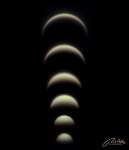 Phases of Venus
21.05.2020
Just as the Moon goes through phases, Venus' visible sunlit hemisphere waxes and wanes. This composite of backyard telescopic images illustrates the steady changes for Venus during its current stint as our evening star, as the inner planet grows larger but narrows to a thin crescent.
 APOD: 2025 August 31 Б NGC 7027: The Pillow Planetary Nebula
31.08.2025
What created this unusual planetary nebula? Dubbed the Pillow Nebula and the Flying Carpet Nebula, NGC 7027 is one of the smallest, brightest, and most unusually shaped planetary nebulas known. Given its expansion rate, NGC 7027 first started expanding, as visible from Earth, about 600 years ago.
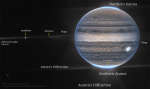 APOD: 2026 January 18 Б Jupiter from the Webb Space Telescope
18.01.2026
This infrared view of Jupiter by Webb is illuminating. High-resolution infrared images of Jupiter from the James Webb Space Telescope (Webb) reveal, for example, differences between high-floating bright clouds -- including the Great Red Spot -- and low-lying dark clouds.
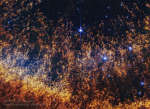 APOD: 2026 August 4 Б Curious Cometary Knots in the Helix Nebula
4.08.2026
What causes unusual knots of gas and dust in planetary nebulas? Seen also in the Ring Nebula, the Dumbbell Nebula and NGC 2392, the knots' existence was not initially predicted, and their origins are still not well understood.
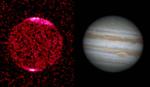 Jupiter s Great X Ray Spot
1.03.2002
The Solar System's largest planet, gas giant Jupiter, is famous for its swirling Great Red Spot. In the right hand panel above, the familiar giant planet with storm system and cloud bands is shown in an optical image from the passing Cassini spacecraft.
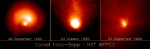 Comet Hale-Bopp Inbound
19.12.1996
Headed toward the inner Solar System, the much anticipated Comet Hale-Bopp has promised to put on a big show next spring. The comet's apparent brightness is currently approaching 4th magnitude and its inbound journey has been closely followed by many observers.
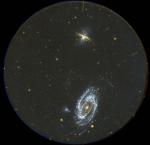 M81 and M82: GALEX Full Field
30.12.2004
Intriguing galaxy pair M81 and M82 shine in this full-field view from the orbiting GALEX observatory. GALEX - the Galaxy Evolution Explorer - scans the cosmos in ultraviolet light, a view that follows star formation and galaxy evolution through the Universe.
 G21.5-0.9: A Supernova s Cosmic Shell
21.04.2005
The picture is lovely, but this pretty cosmic shell was produced by almost unbelievable violence - created when a star with nearly 20 times the mass of the sun blasted away its outer layers in a spectacular supernova explosion.
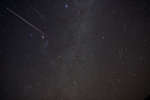 Southern Geminids
18.12.2009
At least 34 meteors are included in this composite image as they rain through Australian skies during the annual Geminid Meteor shower. Dust particles strung out along the orbit of extinct comet Phaethon vaporize when they plow through planet Earth's atmosphere causing the impressive display.
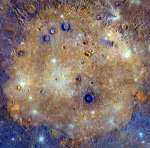 Enhanced Color Caloris
4.03.2015
The sprawling Caloris basin on Mercury is one of the solar system's largest impact basins, created during the early history of the solar system by the impact of a large asteroid-sized body.
|
January February March April May June July August September |
|||||||||||||||||||||||||||||||||||||||||||||||||