
|
You entered: clouds
 Tentacles of the Tarantula Nebula
28.12.2004
The Tarantula Nebula is a giant emission nebula within our neighboring galaxy the Large Magellanic Cloud. Inside this cosmic arachnid lies a huge central young cluster of massive stars, cataloged as R136 and partially visible on the upper right.
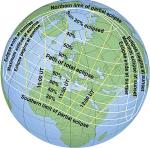 A Total Eclipse for Europe
10.08.1999
The last total solar eclipse of this millennium will be visible for a few minutes tomorrow from a narrow path in Europe and Asia. There, millions of sightseers will witness the Moon move directly between the Earth and Sun, covering up the Sun completely.
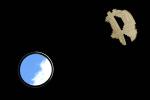 Pantheon Earth and Moon
20.04.2007
Could this be a picture of the Earth and Moon from space? It certainly looks like it at first glance, with a dark, cratered Moon standing off from planet Earth's lovely blue disk surrounded by a nurturing atmosphere. In fact, this view looks up into the dome of the ancient Pantheon in Rome.
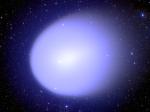 Expansive Comet Holmes
21.11.2007
The spherical coma of Comet Holmes has swollen to a diameter of over 1.4 million kilometers, making the tenuous, dusty cloud even bigger than the Sun. Scattering sunlight, all that dust and gas came...
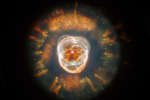 The Eskimo Nebula from Hubble
3.05.2009
In 1787, astronomer William Herschel discovered the Eskimo Nebula. From the ground, NGC 2392 resembles a person's head surrounded by a parka hood. In 2000, the Hubble Space Telescope imaged the Eskimo Nebula. From space, the nebula displays gas clouds so complex they are not fully understood.
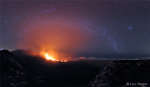 The Milky Way Over the Peak of the Furnace
1.11.2010
On Reunion Island, it is known simply as "The Volcano." To others, it is known as the Piton de la Fournaise, which is French for the Peak of the Furnace. It is one of the most active volcanoes in the world.
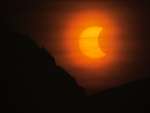 Solar Eclipse over Antarctica
2.12.2011
Last Friday, the fourth and final partial solar eclipse of 2011 was only visible from high latitudes in the southern hemisphere. If you missed it, check out this dramatic picture of the geocentric celestial event from a very high southern latitude on the continent of Antarctica.
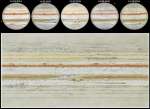 Jupiter Unplugged
2.03.2012
Five hand drawn sketches of Jupiter were used to create this beautifully detailed flat map of the ruling gas giant's turbulent cloud tops. Made with colored pencils at the eyepiece of a 16 inch diameter telescope, the original drawings are about 5 inches (12.5 cm) in diameter.
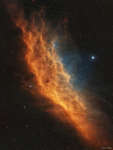 NGC 1499: The California Nebula
6.11.2018
There's even a California in space. Drifting through the Orion Arm of the spiral Milky Way Galaxy, this cosmic cloud by chance echoes the outline of California on the west coast of the United States.
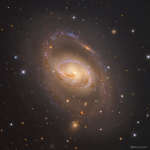 Messier 96
14.04.2022
Spiral arms seem to swirl around the core of Messier 96 in this colorful, detailed portrait of a beautiful island universe. Of course M96 is a spiral galaxy, and counting the faint arms extending beyond the brighter central region it spans 100 thousand light-years or so.
|
January February March April May June July August September |
|||||||||||||||||||||||||||||||||||||||||||||||||