
|
You entered: clouds
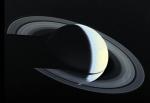 Saturn At Night
3.03.2000
From a spectacular vantage point over 1.4 billion kilometers from the sun, the Voyager 1 spacecraft looked back toward the inner solar system to record this startling view of Saturn's nightside. The picture was taken on November 16, 1980, some four days after the robot spacecraft's closest approach to the gorgeous gas giant.
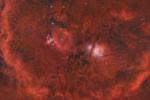 Orion s Cradle
24.01.2007
Cradled in glowing hydrogen, stellar nurseries in Orion lie at the edge of a giant molecular cloud some 1,500 light-years away. This breath-taking view spans about 13 degrees across the center of the well-known constellation with the Great Orion Nebula, the closest large star forming region, just right of center.
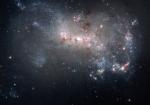 NGC 4449: Close Up of a Small Galaxy
10.07.2007
Grand spiral galaxies often seem to get all the glory. Their newly formed, bright, blue star clusters along beautiful, symmetric spiral arms are guaranteed to attract attention. But small irregular galaxies form stars too, like NGC 4449, located about 12 million light-years away.
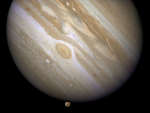 Jupiter Eclipsing Ganymede
5.01.2009
How hazy is Jupiter's upper atmosphere? To help find out, astronomers deployed the Hubble Space Telescope to watch Jupiter eclipse its moon Ganymede. Although Ganymede circles Jupiter once a week, it usually passes above or below the planet, so that a good eclipse occurs more rarely.
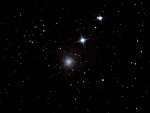 Globular Cluster NGC 2419
22.01.2009
Of three objects prominent in this thoughtful telescopic image, a view toward the stealthy constellation Lynx, two (the spiky ones) are nearby stars. The third is the remote globular star cluster NGC 2419, at distance of nearly 300,000 light-years.
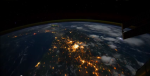 Flying Over the Earth at Night
5.03.2012
Many wonders are visible when flying over the Earth at night. A compilation of such visual spectacles was captured recently from the International Space Station (ISS) and set to rousing music. Passing below are white clouds, orange city lights, lightning flashes in thunderstorms, and dark blue seas.
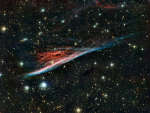 NGC 2736: The Pencil Nebula
24.09.2012
This shock wave plows through space at over 500,000 kilometers per hour. Moving toward to bottom of this beautifully detailed color composite, the thin, braided filaments are actually long ripples in a sheet of glowing gas seen almost edge on. Cataloged as NGC 2736, its narrow appearance suggests its popular name, the Pencil Nebula.
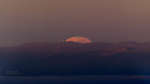 Green Flash at Moonrise
4.06.2015
Follow a sunset on a clear day against a distant horizon and you might glimpse a green flash just as the Sun disappears, the sunlight briefly refracted over a long sight-line through atmospheric layers. You can spot a green flash at sunrise too.
GB-finalLeshin1024.preview.jpg) The Elephant s Trunk Nebula in Cepheus
The Elephant s Trunk Nebula in Cepheus
18.01.2017
Like an illustration in a galactic Just So Story, the Elephant's Trunk Nebula winds through the emission nebula and young star cluster complex IC 1396, in the high and far off constellation of Cepheus. Also known as vdB 142, the cosmic elephant's trunk is over 20 light-years long.
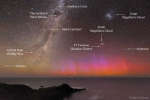 Red Aurora Over Australia
28.01.2017
Why would the sky glow red? Aurora. A solar storm in 2012, emanating mostly from active sunspot region 1402, showered particles on the Earth that excited oxygen atoms high in the Earth's atmosphere. As the excited element's electrons fell back to their ground state, they emitted a red glow.
|
January February March April May June July August September |
|||||||||||||||||||||||||||||||||||||||||||||||||