
|
You entered: telescope
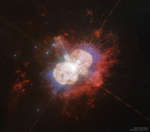 Doomed Star Eta Carinae
20.02.2019
Eta Carinae may be about to explode. But no one knows when - it may be next year, it may be one million years from now. Eta Carinae's mass - about 100 times greater than our Sun - makes it an excellent candidate for a full blown supernova.
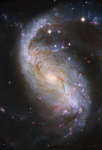 NGC 1672: Barred Spiral Galaxy from Hubble
6.04.2020
Many spiral galaxies have bars across their centers. Even our own Milky Way Galaxy is thought to have a modest central bar. Prominently barred spiral galaxy NGC 1672, featured here, was captured in spectacular detail in an image taken by the orbiting Hubble Space Telescope.
 APOD: 2025 July 26 Б Globular Cluster Omega Centauri
26.07.2025
Globular star cluster Omega Centauri packs about 10 million stars much older than the Sun into a volume some 150 light-years in diameter. Also known as NGC 5139, at a distance...
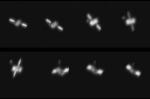 Compton Returns
7.03.2001
On 2000 June 4, the 17-ton Compton Gamma-Ray Observatory returned to Earth after 9 years in orbit -- ending its remarkable voyage of discovery. The massive, bus-sized spacecraft carried an unprecedented array of gamma-ray detectors which explored the bizarre, high-energy universe of solar flares, black holes, pulsars, supernovae, active galaxies, and gamma-ray bursts.
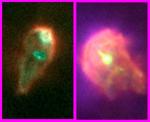 Protoplanetary Survivors in Orion
4.05.2001
The Orion Nebula is a nuturing stellar nursery filled with hot young stars and their natal clouds of gas and dust. But for planetary systems, the active star-forming region can present a hazardous and inhospitable birthplace.
 Orion on Film
7.02.2003
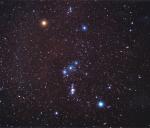
Orion, the Hunter, is one of the most easily recognizable constellations in planet Earth's night sky. But Orion's stars and nebulae don't look quite as colorful to the eye as they do in this lovely photograph, taken last month from Vekol Ranch south of Phoenix, Arizona, USA.
 Asteroid 3753: Earth's Curious Companion
18.06.1997
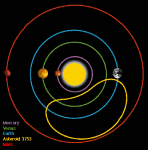
Earth is not alone. It orbits the Sun with a small companion: Asteroid 3753. First discovered in 1986 and designated 1986 OT, this five kilometer rock was recently found to orbit the Sun while executing a strange dance with the Earth. A portion of the asteroid's complex orbit is shown above.
 NGC 6946: The Fireworks Galaxy
25.01.2005
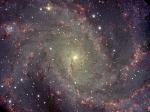
Why is this galaxy so active? Nearby spiral galaxy NGC 6946 is undergoing a tremendous burst of star formation with no obvious cause. In many cases spirals light up when interacting with another galaxy, but NGC 6946 appears relatively isolated in space.
 Infrared Ring Nebula
11.03.2005
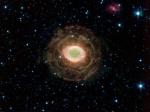
The classic appearance of the popular Ring Nebula (aka M57) is understood to be due to perspective - our view from planet Earth looks down the center of a roughly barrel-shaped cloud of gas.
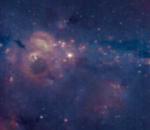 Journey to the Center of the Galaxy
22.04.2000
In Jules Verne's science fiction classic A Journey to the Center of the Earth, Professor Hardwigg and his fellow explorers encounter many strange and exciting wonders. What wonders lie at the center of our Galaxy?
|
January February March April May |
|||||||||||||||||||||||||||||||||||||||||||||||||