
|
You entered: telescope
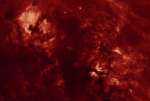 Cygnus Without Stars
24.04.2008
The sky is full of hydrogen, though it can take a sensitive camera and telescope to see it. For example, this twelve-degree-wide view of the northern part of the constellation Cygnus reveals cosmic clouds of hydrogen gas along the plane of our Milky Way galaxy.
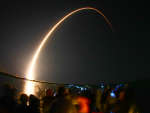 Kepler s Streak
9.03.2009
Streaking skyward, a Delta II rocket carries NASA's Kepler spacecraft aloft into the clear night of March 6. The dramatic scene was recorded in a time exposure from the crowded pier in Jetty Park at the northern end of Cocoa Beach, Florida, about 3 miles from the Cape Canaveral launch site.
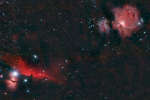 Horsehead and Orion Nebulae
10.03.2009
Adrift 1,500 light-years away in one of the night sky's most recognizable constellations, the glowing Orion Nebula and the dark Horsehead Nebula are contrasting cosmic vistas. They appear in opposite corners of this stunning mosaic taken with a digital camera attached to a small telescope.
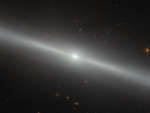 NGC 4762: A Galaxy on the Edge
4.11.2014
Why is there a bright line on the sky? What is pictured above is actually a disk galaxy being seen almost perfectly edge on. The image from the Hubble Space Telescope is a spectacular visual reminder of just how thin disk galaxies can be.
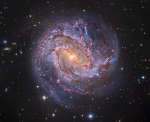 M83: The Thousand Ruby Galaxy
8.10.2015
Big, bright, and beautiful, spiral galaxy M83 lies a mere twelve million light-years away, near the southeastern tip of the very long constellation Hydra. Prominent spiral arms traced by dark dust lanes and blue star clusters lend this galaxy its popular name, The Southern Pinwheel.
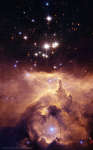 NGC 6357: Cathedral to Massive Stars
27.03.2016
How massive can a normal star be? Estimates made from distance, brightness and standard solar models had given one star in the open cluster Pismis 24 over 200 times the mass of our Sun, making it one of the most massive stars known.
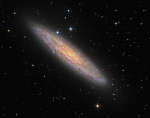 NGC 253: Dusty Island Universe
3.11.2016
Shiny NGC 253 is one of the brightest spiral galaxies visible, and also one of the dustiest. Some call it the Silver Dollar Galaxy for its appearance in small telescopes, or just the Sculptor Galaxy for its location within the boundaries of the southern constellation Sculptor.
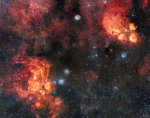 NGC 6357: The Lobster Nebula
7.02.2017
Why is the Lobster Nebula forming some of the most massive stars known? No one is yet sure. Near the more obvious Cat's Paw nebula on the upper right, the Lobster Nebula...
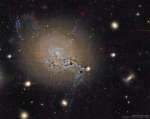 Filaments of Active Galaxy NGC 1275
5.04.2017
What keeps these filaments attached to this galaxy? The filaments persist in NGC 1275 even though the turmoil of galactic collisions should destroy them. First, active galaxy NGC 1275 is the central, dominant member of the large and relatively nearby Perseus Cluster of Galaxies.
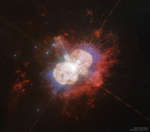 Doomed Star Eta Carinae
20.02.2019
Eta Carinae may be about to explode. But no one knows when - it may be next year, it may be one million years from now. Eta Carinae's mass - about 100 times greater than our Sun - makes it an excellent candidate for a full blown supernova.
|
January February March April May |
|||||||||||||||||||||||||||||||||||||||||||||||||