
|
You entered: dust
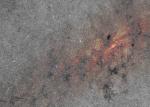 The Galactic Center in Infrared
7.11.2004
The center of our Galaxy is a busy place. In visible light, much of the Galactic Center is obscured by opaque dust. In infrared light, however, dust glows more and obscures less, allowing nearly one million stars to be recorded in the above photograph.
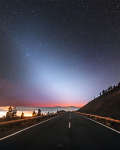 Zodiacal Road
24.07.2019
What's that strange light down the road? Dust orbiting the Sun. At certain times of the year, a band of sun-reflecting dust from the inner Solar System appears prominently just after sunset -- or just before sunrise -- and is called zodiacal light.
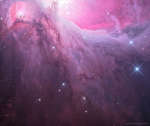 M43: Orion Falls
12.12.2018
Is there a waterfall in Orion? No, but some of the dust in M43 appears similar to a waterfall on Earth. M43, part of the Orion Molecular Cloud Complex, is the often imaged but rarely mentioned neighbor of the more famous M42.
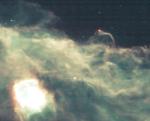 Infrared Horsehead
24.02.2001
This famous cosmic dust cloud was imaged in infrared light by the European Space Agency's Infrared Space Observatory (ISO) satellite. The false-color picture shows the bright infrared emission from dust and molecular gas in part of the Orion star forming region surrounding the Horsehead Nebula.
 Star-Forming Region RCW38 from 2MASS
17.07.2002
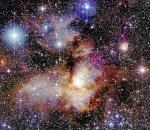
The star cluster in RCW38 was hiding. Looking at the star forming region RCW38 will not normally reveal most of the stars in this cluster. The reason is that the open cluster is so young that it is still shrouded in thick dust that absorbs visible light.
 The Galactic Center in Infrared
7.09.2003
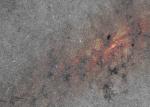
The center of our Galaxy is a busy place. In visible light, much of the Galactic Center is obscured by opaque dust. In infrared light, however, dust glows more and obscures less, allowing nearly one million stars to be recorded in the above photograph.
 In the Center of the Trifid Nebula
30.06.2008
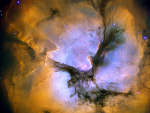
Clouds of glowing gas mingle with lanes of dark dust in the Trifid Nebula, a star forming region toward the constellation of Sagittarius. In the center, the three huge dark dust lanes that give the Trifid its name all come together.
 The Snake Nebula in Ophiuchus
24.08.1997
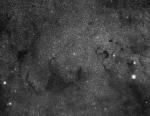
What slithers there? The dark winding lanes visible in part of the constellation Ophiuchus belong to the Snake Nebula. The Snake Nebula is a series of dark absorption clouds made up of Interstellar dust. Interstellar dust grains - composed predominantly of carbon - absorb visible starlight and reradiate much of it in the infrared.
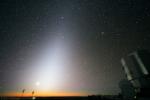 Zodiacal Light and the False Dawn
25.09.2007
An unusual triangle of light will be particularly bright near the eastern horizon before sunrise during the next two months for observers in Earth's northern hemisphere. Once considered a false dawn, this triangle of light is actually Zodiacal Light, light reflected from interplanetary dust particles.
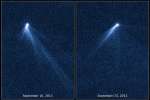 The Unexpected Tails of Asteroid P5
12.11.2013
What is happening to asteroid P/2013 P5? No one is sure. For reasons unknown, the asteroid is now sporting not one but six discernible tails. The above images were taken two months ago by the orbiting Hubble Space Telescope and show the rapidly changing dust streams.
|
January February March April May June July August September |
|||||||||||||||||||||||||||||||||||||||||||||||||