
|
You entered: orbit
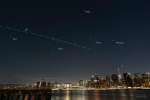 Eclipse in the City
12.11.2022
A darker Moon sets over Manhattan in this night skyscape. The 16 frame composite was assembled from consecutive exposures recorded during the November 8 total lunar eclipse. In the timelapse sequence stars leave short trails above the urban skyline, while the Moon remains immersed in Earth's shadow.
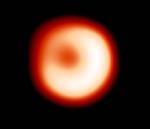 LkHa101: The Hole in the Doughnut
2.03.2001
You'd need a really big cup of coffee with this doughnut ... because the hole in the middle is about a billion kilometers across. Centered on the Sun, a circle that size would lie between the orbits of Mars and Jupiter.
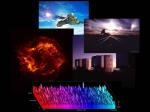 A Year of New Perspectives
28.12.1999
Fittingly, 1999 saw a decade of astronomical discoveries to an end with portents of things to come - embodied in new spacecraft, telescopes, and perspectives to explore the distant Universe across the electromagnetic spectrum. X-ray astronomy in particular will likely flourish in coming
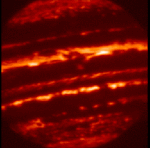 Beneath Jupiter's Clouds
23.01.1996
This near-infrared image of Jupiter was made using instrumentation at NASA's Infrared Telescope Facility, located on the summit of Mauna Kea, Hawaii, in support of the Galileo mission to Jupiter. The brightest spots...
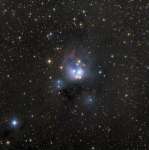 Young Suns of NGC 7129
4.09.2010
Young suns still lie within dusty NGC 7129, some 3,000 light-years away toward the royal constellation Cepheus. While these stars are at a relatively tender age, only a few million years old, it is likely that our own Sun formed in a similar stellar nursery some five billion years ago.
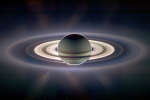 In the Shadow of Saturn
4.09.2011
In the shadow of Saturn, unexpected wonders appear. The robotic Cassini spacecraft now orbiting Saturn drifted in giant planet's shadow for about 12 hours in 2006 and looked back toward the eclipsed Sun. Cassini saw a view unlike any other.
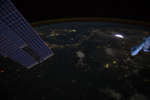 A Dark Earth with a Red Sprite
29.08.2012
There is something very unusual in this picture of the Earth -- can you find it? A fleeting phenomenon once thought to be only a legend has been newly caught if you know just where to look.
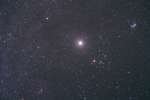 Bright Jupiter in Taurus
27.11.2012
That bright star you've recently noticed rising just after sunset isn't a star at all. It's Jupiter, the solar system's ruling gas giant. Bright Jupiter is nearing its December 3rd opposition when it will stand in Taurus, opposite the Sun in planet Earth's sky.
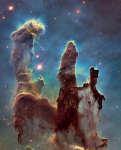 Hubble 25th Anniversary: Pillars of Creation
6.01.2015
To celebrate 25 years (1990-2015) of exploring the Universe from low Earth orbit, the Hubble Space Telescope's cameras were used to revisit its most iconic image. The result is this sharper, wider view of the region dubbed the Pillars of Creation, first imaged by Hubble in 1995.
 Valles Marineris: The Grand Canyon of Mars
29.05.2016
Mars will look good in Earth's skies over the next few days -- but not this good. To get a view this amazing, a spacecraft had to actually visit the red planet. Running across the image center, though, is one the largest canyons in the Solar System.
|
January February March April May June July August September |
|||||||||||||||||||||||||||||||||||||||||||||||||