
|
You entered: galaxies
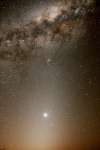 Venus, Zodiacal Light, and the Galactic Center
18.10.2013
The bulging center of our Milky Way Galaxy rests on a pillar of light in this luminous skyscape. Recorded on September 22nd in dark South African skies, rivers of dust seem to flow downward from the galactic center towards Antares, yellowish alpha star of the constellation Scorpius, near the top of the scene.
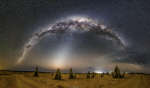 Milky Way and Zodiacal Light over Australian Pinnacles
10.10.2017
What strange world is this? Earth. In the foreground of the featured image are the Pinnacles, unusual rock spires in Nambung National Park in Western Australia. Made of ancient sea shells (limestone), how these human-sized picturesque spires formed remains a topic of research. The panorama was taken last month.
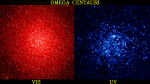 Globular Cluster Omega Centauri
4.10.1996
Does an old, red globular cluster have any hot, blue stars? The rightmost picture, taken by the Ultraviolet Imaging Telescope in ultraviolet light, shows that indeed it does. Pictured, Omega Centauri is the largest known globular cluster in our Galaxy, containing well over a million stars.
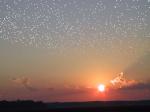 A Flock of Stars
5.10.2001
Only a few stars can be found within ten light-years of our lonely Sun, situated near an outer spiral arm of the Milky Way galaxy. But if our Sun were found within a star cluster, thousands of stars might occupy a similar space.
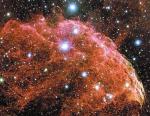 Galactic Supernova Remnant IC 443
3.09.2003
About 8000 years ago, a star in our Galaxy exploded. Ancient humans might have noticed the supernova as a temporary star, but modern humans can see the expanding shell of gas even today. Pictured...
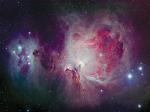 The Great Nebula in Orion
27.09.2004
The Great Nebula in Orion is a colorful place. Visible to the unaided eye, it appears as a small fuzzy patch in the constellation of Orion. Long exposure, digitally sharpened images like this, however, show the Orion Nebula to be a busy neighborhood of young stars, hot gas, and dark dust.
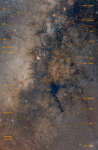 The Annotated Galactic Center
31.08.2010
The sky toward the center of our Galaxy is filled with a wide variety of celestial wonders, many of which are visible from a dark location with common binoculars. Constellations near the Galactic Center include Sagittarius, Libra, Scorpius, Scutum, and Ophiuchus.
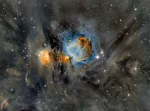 Orion Nebula in Surrounding Dust
25.03.2014
What surrounds a hotbed of star formation? In the case of the Orion Nebula -- dust. The entire Orion field, located about 1600 light years away, is inundated with intricate and picturesque filaments of dust.
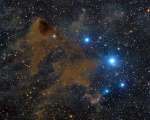 Lynds Dark Nebula 183
21.10.2017
Beverly Lynds Dark Nebula 183 lies a mere 325 light-years away, drifting high above the plane of our Milky Way Galaxy. Obscuring the starlight behind it when viewed at optical wavelengths, the dark, dusty molecular cloud itself seems starless.
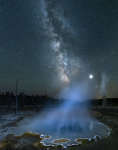 Milky Way over Yellowstone
29.01.2020
The Milky Way was not created by an evaporating lake. The pool of vivid blue water, about 10 meters across, is known as Silex Spring and is located in Yellowstone National Park in Wyoming, USA. Steam rises off the spring, heated by a magma chamber deep underneath known as the Yellowstone hotspot.
|
January February March April May |
|||||||||||||||||||||||||||||||||||||||||||||||||