
|
You entered: galaxies
 The Early Universe
14.06.1997
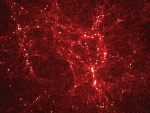
What did our universe look like when it was young? To answer this, cosmologists run sophisticated computer programs tracking the locations of millions of particles. The above animated frame is the result of such a calculation and shows how our universe might have looked when it was just a fracton of its current age.
 The Sloan Digital Sky Survey Telescope
17.06.1998
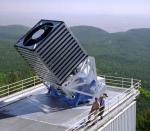
The Sloan Digital Sky Survey (SDSS) will soon begin. Pictured above is the 2.5-meter telescope poised to create the most ambitious sky map in the history of astronomy. SDSS will catalog one quarter of the sky down past 23rd magnitude ( R), obtaining redshifts for galaxies and quasars brighter than magnitude 19.
 The Waterfall and the World at Night
17.05.2013
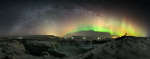
Above this boreal landscape, the arc of the Milky Way and shimmering aurorae flow through the night. Like an echo, below them lies Iceland's spectacular Godafoss, the Waterfall of the Gods. Shining just below the Milky Way, bright Jupiter is included in the panoramic nightscape recorded on March 9.
 An Aurora Cupcake with a Milky Way Topping
9.09.2014
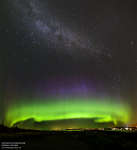
This sky looked delicious. Double auroral ovals were captured above the town lights of жstersund, Sweden, last week. Pictured above, the green ovals occurred lower to the ground than violet aurora rays above, making the whole display look a bit like a cupcake.
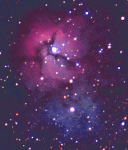 M20: The Trifid Nebula
23.07.1995
The vivid blue and violet colors present in the Trifid Nebula result from the abundance of young stars there. The light from young massive stars is quite blue and has the ability to remove electrons from surrounding gas. When these electrons re-combine with the gas, radiation rich in blue and violet light is emitted.
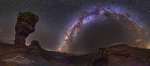 Milky Way and Stone Tree
29.04.2013
What's that next to the Milky Way? An unusual natural rock formation known as Roque Cinchado or Stone Tree found on the Spanish Canary Island of Tenerife. A famous icon, Roque Cinchado is likely a dense plug of cooled volcanic magma that remains after softer surrounding rock eroded away.
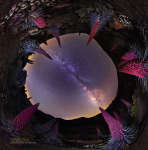 Planet of the Tajinastes
25.05.2019
What bizarre planet are these alien creatures from? It's only planet Earth, of course. The planet's home galaxy the Milky Way stretches across a dark sky in the panoramic, fisheye all-sky projection composed with a wide lens. But the imposing forms gazing skyward probably look strange to many denizens of Earth.
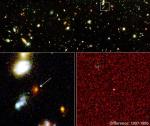 Distant Supernova Dark Energy
4.04.2001
Light from a star that exploded over 10 billion light-years away is revealed in the panel at the lower right, a cosmic snapshot of the most distant supernova. The ancient stellar detonation was detected...
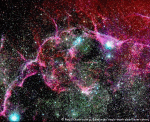 Vela Supernova Remnant in Optical
13.06.1996
About 11,000 years ago a star in the constellation of Vela exploded. This bright supernova may have been visible to the first human farmers. Today the Vela supernova remnant marks the position of a relatively close and recent explosion in our Galaxy. A roughly spherical, expanding shock wave is visible in X-rays.
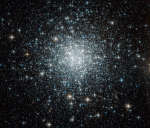 Globular Star Cluster NGC 6934
9.10.2010
Globlular star clusters roam the halo of our Milky Way Galaxy. Gravitationally bound, these spherical groupings of typically several hundred thousand stars are ancient, older than the stars of the galactic disk. In fact...
|
January February |
|||||||||||||||||||||||||||||||||||||||||||||||||