
|
You entered: surface
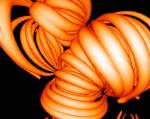 Solar Magnetic Bananas
29.06.1998
Is that our Sun? The unusual banana-shaped loops shown above are actually part of a computer-generated snap-shot of our Sun's magnetic field. This animated frame was constructed using data from the ground-based U.S. Solar Vector Magnetograph and the space-based Japanese X-Ray Telescope Yohkoh.
 APOD: 2023 November 7 Б A Martian Dust Devil Spins By
7.11.2023
It moved across the surface of Mars -- what was it? A dust devil. Such spinning columns of rising air are heated by the warm surface and are also common in warm and dry areas on planet Earth.
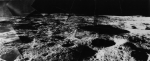 Surveyor Hops
5.12.1998
This panorama of the cratered lunar surface was constructed from images returned by the US Surveyor 6 lander. Surveyor 6 was not the first spacecraft to accomplish a soft landing on the Moon ... but it was the first to land and then lift off again!
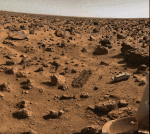 Utopia on Mars
22.07.1996
The Viking 2 spacecraft was launched on the Road to Utopia in September of 1975 (30 years after Bing, Dotty, and Bob). In August of 1976, after making the second successful Martian landing, Viking...
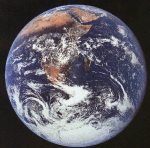 Welcome to Planet Earth
31.01.1999
Welcome to Planet Earth, the third planet from a star named the Sun. The Earth is shaped like a sphere and composed mostly of rock. Over 70 percent of the Earth's surface is water. The planet has a relatively thin atmosphere composed mostly of nitrogen and oxygen.
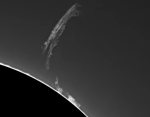 A Filament Leaps from the Sun
8.11.2021
Why, sometimes, does part of the Sun's atmosphere leap into space? The reason lies in changing magnetic fields that thread through the Sun's surface. Regions of strong surface magnetism, known as active regions, are usually marked by dark sunspots.
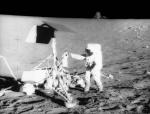 Apollo 12 Visits Surveyor 3
3.03.2001
Apollo 12 was the second mission to land humans on the Moon. The landing site was picked to be near the location of Surveyor 3, a robot spacecraft that had landed on the Moon three years earlier.
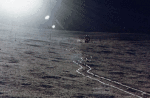 Apollo 14: Rickshaw Tracks Across the Moon
27.04.1996
Brilliant sunlight glints off tracks gently winding across the the Moon's Frau Maro highlands. The tracks were made by the Apollo 14 crew's two-wheeled Modularized Equipment Transporter (MET), fondly known as the "rickshaw". The MET was designed as an aid to surface exploration.
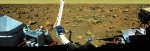 The Search for Life on Mars
21.07.1995
Although images of Mars taken from space revealed the planet to have a barren and cratered surface, scientists did not give up the search for martian life. In 1976 NASA's Viking project succeeded in landing two robot probes on the surface of Mars.
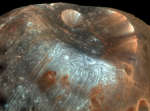 Stickney Crater
18.01.2013
Stickney Crater, the largest crater on the martian moon Phobos, is named for Chloe Angeline Stickney Hall, mathematician and wife of astronomer Asaph Hall. Asaph Hall discovered both the Red Planet's moons in 1877.
|
January February March April May June July August September October |
|||||||||||||||||||||||||||||||||||||||||||||||||