
|
You entered: nearest stars
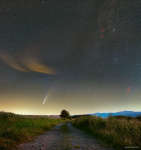 Comet NEOWISE and Nebulae
20.07.2020
Would you brave wild animals to photograph this sky? One astrophotographer did -- and we all get to reap the rewards. First, thousands of stars were visible with many of the brightest impressively blue. Next, several red-glowing nebulae were discernible, including the California Nebula on the far right, and, above it, the Heart and Soul nebulae.
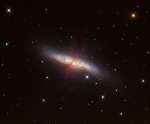 Bright Supernova in M82
24.01.2014
Astronomers really don't find supernovae by looking for the arrows. But in this image taken January 23rd, an arrow does point to an exciting, new supernova, now cataloged as SN 2014J, in nearby bright galaxy M82.
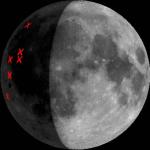 Moon Struck
8.12.1999
Craters produced by ancient impacts on the airless Moon have long been a familiar sight. But now observers have seen elusive optical flashes on the lunar surface - likely the fleeting result of impacting meteoroids. Orchestrated by David Dunham, president of the International Occultation
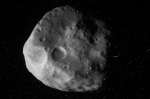 Views from Cassini at Saturn
18.06.2017
What has the Cassini orbiter seen at Saturn? The featured music video shows some of the early highlights. In the first time-lapse sequence (00:07), a vertical line appears that is really Saturn's thin rings seen nearly edge-on. Soon some of Saturn's moon shoot past.
 The Black Hole in the Milky Way
2.11.2012
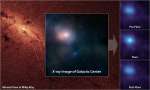
At the center of our Milky Way Galaxy, a mere 27,000 light-years away, lies a black hole with 4 million times the mass of the Sun. Fondly known as Sagittarius A* (pronounced A-star)...
 APOD: 2017 November 22 Oumuamua: Interstellar Asteroid
22.11.2017
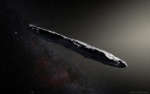
Nothing like it has ever been seen before. The unusual space rock 'Oumuamua is so intriguing mainly because it is the first asteroid ever detected from outside our Solar System -- although likely many more are to follow given modern computer-driven sky monitoring.
 Galaxy Wars: M81 and M82
20.01.2023
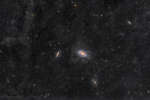
The two dominant galaxies near center are far far away, 12 million light-years distant toward the northern constellation of the Great Bear. On the right, with grand spiral arms and bright yellow core is spiral galaxy M81. Also known as Bode's galaxy, M81 spans some 100,000 light-years.
 Tails Of Comet LINEAR
27.07.2000
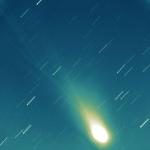
Comet C/1999 S4 LINEAR is only one of many comets discovered with the Lincoln Near Earth Asteroid Research (LINEAR) telescope operating near Soccoro, New Mexico, USA. Traveling steadily southward through Earth's night...
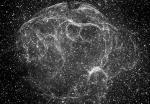 Simeis 147: Supernova Remnant
30.08.2002
It's easy to get lost following the intricate filaments in this stunningly detailed image of faint supernova remnant Simeis 147. Seen towards the constellation Taurus it covers nearly 3 degrees (6 full moons)...
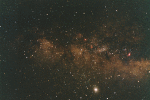 Hale-Bopp, Jupiter, and the Milky Way
23.07.1996
Shining brightly, the mighty Jupiter rules this gorgeous Kodacolor photo of the Milky Way near Sagittarius. Astronomer Bill Keel took the picture earlier this month (July 7) while standing near the summit of Hawaii's Mauna Kea contemplating the sky in the direction of the center of the Galaxy (right of picture center).
|
January February March April May June July August September October |
|||||||||||||||||||||||||||||||||||||||||||||||||