
|
You entered: stars
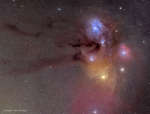 The Dark River to Antares
21.02.2015
Connecting the Pipe Nebula to the colorful region near bright star Antares is a dark cloud dubbed the Dark River, flowing from the picture's left edge. Murky looking, the Dark River's appearance is caused by dust obscuring background starlight, although the dark nebula contains mostly hydrogen and molecular gas.
 VAR
VAR
1.07.2011
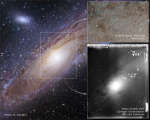
In the 1920s, examining photographic plates from the Mt. Wilson Observatory's 100 inch telescope, Edwin Hubble determined the distance to the Andromeda Nebula, decisively demonstrating the existence of other galaxies far beyond the Milky Way.
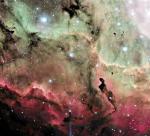 Close Up of the Lagoon Nebula
16.08.2004
Stars are battling gas and dust in the Lagoon Nebula but the photographers are winning. Also known as M8, this photogenic nebula is visible even without binoculars towards the constellation of Sagittarius. The energetic processes of star formation create not only the colors but the chaos.
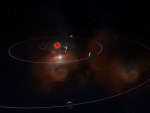 BLG 109: A Distant Version of our own Solar System
18.02.2008
How common are planetary systems like our own? Perhaps quite common, as the first system of planets like our own Solar System has been discovered using a newly adapted technique that, so far, has probed only six planetary systems.
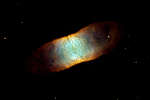 IC 4406: A Seemingly Square Nebula
27.07.2008
How can a round star make a square nebula? This conundrum comes to light when studying planetary nebulae like IC 4406. Evidence indicates that IC 4406 is likely a hollow cylinder, with its square appearance the result of our vantage point in viewing the cylinder from the side.
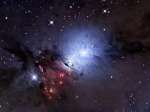 NGC 1333 Stardust
18.04.2009
NGC 1333 is seen in visible light as a reflection nebula, dominated by bluish hues characteristic of starlight reflected by dust. A mere 1,000 light-years distant toward the heroic constellation Perseus, it lies at the edge of a large, star-forming molecular cloud.
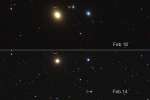 Vesta Near Opposition
18.02.2010
Main belt asteroid 4 Vesta is at its brightest now. The small world is near opposition (opposite the Sun in the sky) and closest to Earth. But even at its brightest, Vesta is just too faint to spot with the naked-eye.
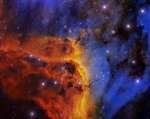 IC 5067 in the Pelican Nebula
26.05.2016
The prominent ridge of emission featured in this sharp, colorful skyscape is cataloged as IC 5067. Part of a larger emission nebula with a distinctive shape, popularly called The Pelican Nebula, the ridge spans about 10 light-years following the curve of the cosmic pelican's head and neck.
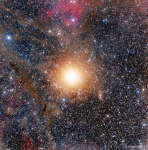 Behind Betelgeuse
11.05.2020
What's behind Betelgeuse? One of the brighter and more unusual stars in the sky, the red supergiant star Betelgeuse can be found in the direction of famous constellation Orion. Betelgeuse, however, is actually...
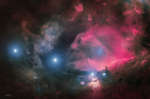 Orions Belt Region in Gas and Dust
11.01.2022
You may have seen Orion's belt before -- but not like this. The three bright stars across this image are, from left to right, Mintaka, Alnilam, and Alnitak: the iconic belt stars of Orion.
|
January February March April May June July August September |
|||||||||||||||||||||||||||||||||||||||||||||||||