
|
You entered: universe
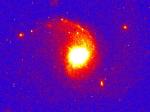 Quasar in an Elliptical Galaxy
9.04.1998
Where do quasars live? Quasars are the brightest objects in the universe, so bright they can be seen from across the universe. Observations continue to show that most quasars are surrounded by a relatively faint nebulous patch. Astronomers are trying to identify the nature of these patches.
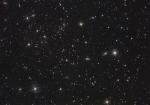 Time Tunnel
6.09.2007
Spiky stars are nearby, but fuzzy galaxies are strewn far across the Universe in this cosmic view. Spanning about 1/2 degree on the sky, the pretty picture is the result of astronomer Johannes Schedler's project to look back in time, toward a quasar 12.7 billion light-years away.
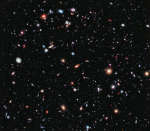 The Hubble Extreme Deep Field
14.10.2012
What did the first galaxies look like? To help answer this question, the Hubble Space Telescope has just finished taking the eXtreme Deep Field (XDF), the deepest image of the universe ever taken in visible light.
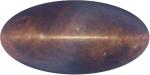 The Far Infrared Sky
17.05.2000
Three major sources contribute to the far-infrared sky: our Solar System, our Galaxy, and our Universe. The above recently released image, in representative colors, is the highest resolution projection yet created of the entire far-infrared sky (60 - 240 microns) created from years of observations by the now-defunct robot spacecraft COBE.
 APOD: 2024 September 11 Б A Night Sky over the Tatra Mountains
11.09.2024
A natural border between Slovakia and Poland is the Tatra Mountains. A prominent destination for astrophotographers, the Tatras are the highest mountain range in the Carpathians. In the featured image taken...
 On the Origin of Gold
15.05.2005
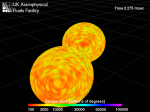
Where did the gold in your jewelry originate? No one is completely sure. The relative average abundance in our Solar System appears higher than can be made in the early universe, in stars, and even in typical supernova explosions.
 Two Billion Years After the Big Bang
7.09.1996
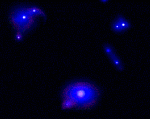
What did the universe look like two billion years after the Big Bang? According to this computer model, the universe was filled with irregular looking objects like the ones shown above. The simulation then predicts that these blobs of stars and gas collide to form galaxies more similar to the ones we see today.
 Redshift 10: Evidence for a New Farthest Galaxy
17.03.2004
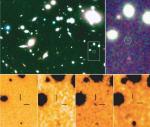
What's the farthest galaxy known? The answer keeps changing as astronomers compete to find galaxies that top the list. The new claimed record holder is now the faint smudge indicated in the above images by an 8.2-meter Very Large Telescope (VLT) operating in Chile.
 PG 1115: A Ghost of Lensing Past
2.11.1998
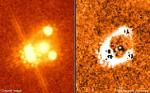
In this tangle of quasars and galaxies lies a clue to the expansion rate of the universe. A diffuse glow evident in the picture on the left reveals a normal elliptical galaxy. Directly behind this galaxy lies a normal quasar.
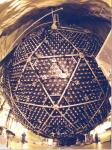 The Sudbury Neutrino Detector
23.06.1999
Two thousand meters below the ground, a giant sphere has begun to detect nearly invisible particles. These particles, neutrinos, are extremely abundant in the universe but usually go right through just about everything.
|
January February March April May June July August September |
|||||||||||||||||||||||||||||||||||||||||||||||||