
|
You entered: universe
 On the Origin of Gold
11.09.2011
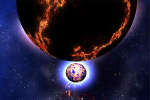
Where did the gold in your jewelry originate? No one is completely sure. The relative average abundance in our Solar System appears higher than can be made in the early universe, in stars, and even in typical supernova explosions.
 Night Launch of Endeavour
7.08.1995
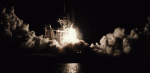
Space Shuttle Endeavour thunders off into orbit in a rare night launch. This March 1995 mission is most famous for operating the set of astronomical telescopes known as Astro-2. Astro-2's telescopes observed the universe in ultraviolet light - light so blue humans by themselves can't see it.
 The Year of Distant Supernovae
31.12.1998
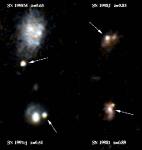
Distant supernovae were among topics at the forefront of astronomy during 1998. Two independent groups raced to deploy large telescopes to scan the sky, discovering and analyzing far-off supernovae with the promise of calibrating the geometry of our universe.
 On the Origin of Gold
18.05.2008
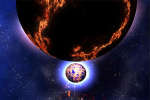
Where did the gold in your jewelry originate? No one is completely sure. The relative average abundance in our Solar System appears higher than can be made in the early universe, in stars, and even in typical supernova explosions.
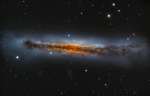 Edge on NGC 3628
20.06.2013
Sharp telescopic views of magnificent edge-on spiral galaxy NGC 3628 show a puffy galactic disk divided by dark dust lanes. Of course, this deep galactic portrait puts some astronomers in mind of its popular moniker, The Hamburger Galaxy.
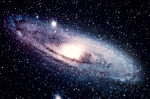 M31: The Andromeda Galaxy
24.07.1995
Andromeda is the nearest major galaxy to our own Milky Way Galaxy. Our Galaxy is thought to look much like Andromeda. Together these two galaxies dominate the Local Group of galaxies. The diffuse light from Andromeda is caused by the hundreds of billions of stars that compose it.
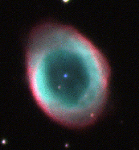 M57: The Ring Nebula
27.07.1995
A star with mass similar to that of our Sun will throw off its outer gasses after fusion has stopped in its core. Possibly the most visually spectacular of these planetary nebula is the pictured Ring Nebula. The appearance as a ring is really an illusion of projection - the nebula is actually a spherical shell.
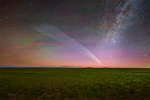 APOD: 2025 December 30 Б An Artificial Comet
30.12.2025
Yes, but can your comet tail do this? No, and what you are seeing is not the tail of a comet. The picture features a cleverly overlayed time-lapse sequence of a group of satellites orbiting Earth together in June.
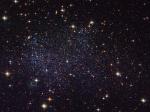 Sagittarius Dwarf Irregular Galaxy
16.11.2004
How old is this galaxy? The nearby Local Group galaxy dubbed the Sagittarius Dwarf Irregular Galaxy (SagDIG) is not only very small but also has relatively few elements more massive than helium.
 David N. Schramm, 1945 - 1997
22.12.1997
David N. Schramm effectively combined the very big with the very small. Among his many scientific achievements, Schramm and collaborators successfully used Big Bang cosmology to predict that only three families of elementary particles exist in the universe, which was subsequently confirmed by high energy particle accelerators.
|
January February March April May June July August September |
|||||||||||||||||||||||||||||||||||||||||||||||||