
|
You entered: molecular cloud
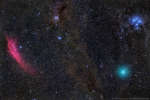 Red Nebula, Green Comet, Blue Stars
20.12.2018
This festively colored skyscape was captured in the early morning hours of December 17, following Comet Wirtanen's closest approach to planet Earth. The comet was just visible to the eye. The lovely green...
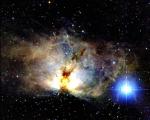 The Flame Nebula in Infrared
13.07.1999
What lights up the Flame Nebula? Fifteen hundred light years away towards the constellation of Orion lies a nebula which, from its glow and dark dust lanes, appears like a billowing fire. But fire, the rapid acquisition of oxygen, is not what makes this Flame glow.
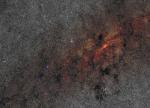 The Galactic Center in Infrared
16.07.2006
The center of our Galaxy is a busy place. In visible light, much of the Galactic Center is obscured by opaque dust. In infrared light, however, dust glows more and obscures less, allowing nearly one million stars to be recorded in the above photograph.
 APOD: 2024 October 27 Б LDN 43: The Cosmic Bat Nebula
27.10.2024
What is the most spook-tacular nebula in the galaxy? One contender is LDN 43, which bears an astonishing resemblance to a vast cosmic bat flying amongst the stars on a dark Halloween night. Located...
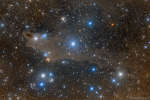 The Shark Nebula
7.09.2015
There is no sea on Earth large enough to contain the Shark nebula. This predator apparition poses us no danger, though, as it is composed only of interstellar gas and dust. Dark dust like that featured here is somewhat like cigarette smoke and created in the cool atmospheres of giant stars.
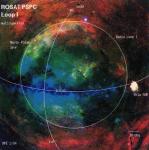 Loop I in the Northern Sky
3.05.1999
One of the largest coherent structures on the sky is known simply as Loop I and can best be seen in radio and X-ray maps. Spanning over 100 degrees, part of Loop I appears so prominent in northern sky maps that it is known as the North Polar Spur (NPS).
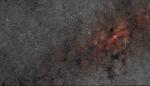 The Galactic Center in Infrared
21.06.1999
The center of our Galaxy is a busy place. In visible light, much of the Galactic Center is obscured by opaque dust. In infrared light, however, dust glows more and obscures less, allowing nearly one million stars to be recorded in the above photograph.
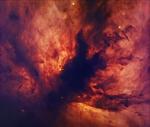 Flame Nebula Close Up
2.02.2007
Of course, the Flame Nebula is not on fire. Also known as NGC 2024, the nebula's suggestive reddish color is due to the glow of hydrogen atoms at the edge of the giant Orion molecular cloud complex some 1,500 light-years away.
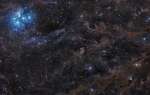 Sisters of the Dusty Sky
18.11.2010
Hurtling through a cosmic dust cloud some 400 light-years away, the lovely Pleiades or Seven Sisters star cluster is well-known for its striking blue reflection nebulae. In the dusty sky toward the constellation Taurus and the Orion Arm of our Milky Way Galaxy, this remarkable image shows the famous star cluster at the upper left.
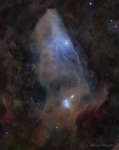 APOD: 2026 April 7 Б IC 4592: The Blue Horsehead Reflection Nebula
7.04.2026
Do you see the horse's head? What you are seeing is not the famous Horsehead nebula toward Orion, but rather a fainter nebula that only takes on a familiar form with deeper imaging. The main part of the here-imaged molecular cloud complex is reflection nebula IC 4592.
|
January February March April May |
|||||||||||||||||||||||||||||||||||||||||||||||||