
|
You entered: stars
 A MACHO View of Galactic Dark Matter
2.02.1996
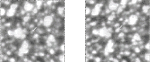
What is our Galaxy made of? Stellar motions indicate there is much more mass than just stars and gas. Photographs like the two shown above may be yielding a clue about the dark matter, however.
 M95 with Supernova
22.03.2012
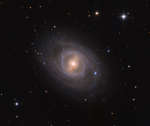
Barred spiral galaxy M95 is about 75,000 light-years across, comparable in size to our own Milky Way and one of the larger galaxies of the Leo I galaxy group. In fact, it is part of a not quite so famous trio of Leo galaxies with neighbors M96 and M105, about 38 million light-years distant.
 Eclipse in the City
12.11.2022
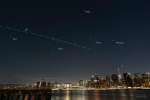
A darker Moon sets over Manhattan in this night skyscape. The 16 frame composite was assembled from consecutive exposures recorded during the November 8 total lunar eclipse. In the timelapse sequence stars leave short trails above the urban skyline, while the Moon remains immersed in Earth's shadow.
 APOD: 2023 May 8 Б The Spanish Dancer Spiral Galaxy
8.05.2023
If not perfect, then this spiral galaxy is at least one of the most photogenic. An island universe containing billions of stars and situated about 40 million light-years away toward the constellation of the Dolphinfish (Dorado), NGC 1566 presents a gorgeous face-on view.
 APOD: 2024 April 16 Б Filaments of the Vela Supernova Remnant
16.04.2024
The explosion is over, but the consequences continue. About eleven thousand years ago, a star in the constellation of Vela could be seen to explode, creating a strange point of light briefly visible to humans living near the beginning of recorded history.
 APOD: 2026 February 3 Б Red Spider Planetary Nebula from Webb
3.02.2026
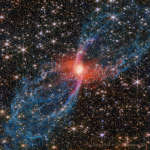
Oh what a tangled web a planetary nebula can weave. The Red Spider Planetary Nebula shows the complex structure that can result when a normal star ejects its outer gases and becomes a white dwarf star.
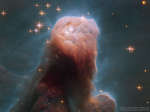 The Cone Nebula from Hubble
15.03.2017
Stars are forming in the gigantic dust pillar called the Cone Nebula. Cones, pillars, and majestic flowing shapes abound in stellar nurseries where natal clouds of gas and dust are buffeted by energetic winds from newborn stars. The Cone Nebula, a well-known example, lies within the bright galactic star-forming region NGC 2264.
 APOD: 2025 January 29 Б Dust Shells around WR 140 from Webb
29.01.2025
What are those strange rings? Rich in dust, the rings are likely 3D shells -- but how they were created remains a topic of research. Where they were created is well known: in a binary...
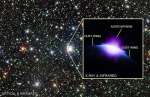 APOD: 2026 March 6 Б The Astrosphere of HD 61005
6.03.2026
Do young stars blow bubbles? The larger view shows a stellar field observed with the Cerro Tololo Inter-American Observatory in Chile, and the inset highlights HD 61005, a star like our Sun, only 120 light-years away.
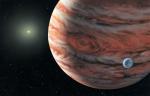 55 Cancri: Familiar Planet Discovered
14.06.2002
Is our Solar System unique? The discovery of a Jupiter-like planet in a Jupiter-like orbit around nearby Sun-like star 55 Cancri, announced yesterday, gives a new indication that planetary systems similar to our Solar System likely exist elsewhere. The planet, discovered by G.
|
January February March April May June July August September |
|||||||||||||||||||||||||||||||||||||||||||||||||