
|
You entered: stars
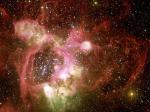 The N44 Emission Nebula
13.02.2006
N44 is one of the largest and most intricate nebulas in this part of the universe. Located in our galactic neighbor the Large Magellanic Cloud, N44 houses numerous massive bright stars, lengthy lanes of dark dust, and vast clouds of hydrogen gas that glows red.
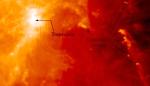 Cometary Globules In Orion
24.09.1999
Intense ultraviolet light from massive, hot stars in the Orion region has sculpted and compressed clouds of dust and gas in to distinctively shaped Cometary Globules. Seen in this IRAS infrared image recorded...
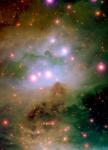 The Colorful Orion Nebula
14.09.1999
The Great Nebula in Orion is a colorful place. Visible to the unaided eye as a fuzzy patch in the constellation of Orion, this image taken with the Big Throughput Camera shows the Orion Nebula to be a busy neighborhood of young stars, hot gas, and dark dust.
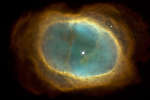 NGC 3132: The Eight Burst Nebula
26.06.2011
It's the dim star, not the bright one, near the center of NGC 3132 that created this odd but beautiful planetary nebula. Nicknamed the Eight-Burst Nebula and the Southern Ring Nebula, the glowing gas originated in the outer layers of a star like our Sun.
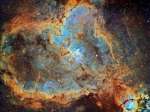 IC 1805: The Heart Nebula
4.03.2013
Sprawling across almost 200 light-years, emission nebula IC 1805 is a mix of glowing interstellar gas and dark dust clouds. Derived from its Valentine's-Day-approved shape, its nickname is the Heart Nebula. About 7,500 light-years away in the Perseus spiral arm of our galaxy, stars were born in IC 1805.
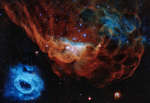 Hubble s Cosmic Reef
25.04.2020
These bright ridges of interstellar gas and dust are bathed in energetic starlight. With its sea of young stars, the massive star-forming region NGC 2014 has been dubbed the Cosmic Reef. Drifting just...
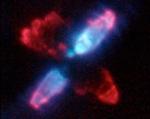 Shells in the Egg Nebula
20.05.1997
The Egg Nebula is taking a beating. Like a baby chick pecking its way out of an egg, the star in the center of the Egg Nebula is casting away shells of gas and dust as it slowly transforms itself into a white dwarf star.
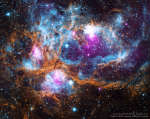 NGC 6357: Stellar Wonderland
26.12.2016
For reasons unknown, NGC 6357 is forming some of the most massive stars ever discovered. This complex wonderland of star formation consists of numerous filaments of dust and gas surrounding huge cavities of massive star clusters. The intricate patterns are caused by complex interactions between interstellar winds, radiation pressures, magnetic fields, and gravity.
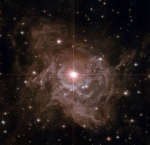 Nearby Cepheid Variable RS Pup
9.09.2013
It is one of the most important stars in the sky. This is partly because, by coincidence, it is surrounded by a dazzling reflection nebula. Pulsating RS Puppis, the brightest star in the image center, is some ten times more massive than our Sun and on average 15,000 times more luminous.
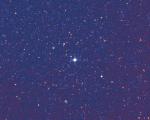 A Close Encounter Of The Stellar Kind
7.07.2001
The unassuming star centered in this sky view will one day be our next door stellar neighbor. The faint 9th magnitude red dwarf, currently 63 light-years away in the constellation Ophiucus, was recently discovered to be approaching our Solar System.
|
January February March April May June July August September |
|||||||||||||||||||||||||||||||||||||||||||||||||