
|
You entered: Orion
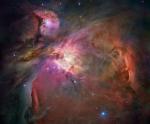 Orion Nebula, The Hubble View
19.01.2006
Few cosmic vistas excite the imagination like the Orion Nebula. Also known as M42, the nebula's glowing gas surrounds hot young stars at the edge of an immense interstellar molecular cloud only 1,500 light-years away.
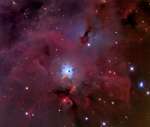 NGC 1999: South of Orion
24.02.2011
South of the large star-forming region known as the Orion Nebula, lies bright blue reflection nebula NGC 1999. Also at the edge of the Orion molecular cloud complex some 1,500 light-years distant, NGC 1999's illumination is provided by the embedded variable star V380 Orionis.
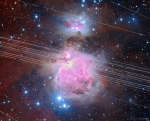 Starlink over Orion
1.06.2021
What are those streaks across Orion? Most are reflections of sunlight from numerous Earth-orbiting Starlink satellites. Appearing by eye as a series of successive points floating across a twilight sky, the increasing number of SpaceX Starlink communication satellites are causing concern among many astronomers.
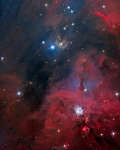 South of Orion
27.01.2022
South of the large star-forming region known as the Orion Nebula, lies bright blue reflection nebula NGC 1999. At the edge of the Orion molecular cloud complex some 1,500 light-years distant, NGC 1999's illumination is provided by the embedded variable star V380 Orionis.
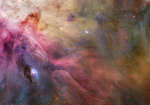 LL Ori and the Orion Nebula
3.02.2013
This esthetic close-up of cosmic clouds and stellar winds features LL Orionis, interacting with the Orion Nebula flow. Adrift in Orion's stellar nursery and still in its formative years, variable star LL Orionis produces a wind more energetic than the wind from our own middle-aged Sun.
 Planet Earth from Orion
18.11.2023
One year ago a Space Launch System rocket left planet Earth on November 16, 2022 at 1:47am EST carrying the Orion spacecraft on the Artemis I mission, the first integrated test of NASAБs deep space exploration systems.
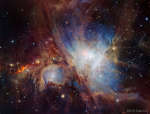 The Orion Nebula in Infrared from HAWK I
18.07.2016
The deepest infrared image of the Orion Nebula has uncovered a bonanza of previously unknown low-mass stars and -- quite possibly -- free floating planets. The picturesque nebula is best known in visible light where it shows a many bright stars and bright glowing gas.
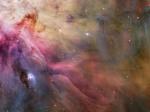 LL Ori and the Orion Nebula
20.01.2006
This esthetic close-up of cosmic clouds and stellar winds features LL Orionis, interacting with the Orion Nebula flow. Adrift in Orion's stellar nursery and still in its formative years, variable star LL Orionis produces a wind more energetic than the wind from our own middle-aged Sun.
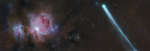 APOD: 2026 May 12 Б The Conjunction of Comet R3 PanSTARRS and the Orion Nebula
12.05.2026
TodayБs composite image features something old, something new, something borrowed, and something blue! Comet R3 PanSTARRS, streaking across the right of the image, likely originated from the Oort Cloud, meaning it is an old Solar System relic from billions of years ago.
 APOD: 2023 October 10 Б Hidden Orion from Webb
10.10.2023
The Great Nebula in Orion has hidden stars. To the unaided eye in visible light, it appears as a small fuzzy patch in the constellation of Orion. But this image was taken by the Webb Space Telescope in a representative-color composite of red and very near infrared light.
|
January February March April May June July August September |
|||||||||||||||||||||||||||||||||||||||||||||||||