
|
You entered: Orion
 APOD: 2025 August 13 Б Trapezium: In the Heart of Orion
12.08.2025
What lies in the heart of Orion? Trapezium: four bright stars, that can be found near the center of this sharp cosmic portrait. Gathered within a region about 1.5 light-years in radius, these stars dominate the core of the dense Orion Nebula Star Cluster.
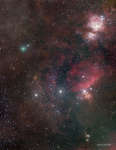 Comet ATLAS and Orion s Belt
11.11.2020
With its closest approach to planet Earth scheduled for November 14, this Comet ATLAS (C/2020 M3) was discovered just this summer, another comet found by the NASA funded Asteroid Terrestrial-impact Last Alert System.
 Orion and the Ocean of Storms
12.12.2025
On December 5, 2022, a camera on board the uncrewed Orion spacecraft captured this view as Orion approached its return powered flyby of the Moon. Beyond one of Orion's extended solar arrays lies dark, smooth, terrain along the western edge of the Oceanus Procellarum.
 M42: Inside the Orion Nebula
8.04.2014
The Great Nebula in Orion, an immense, nearby starbirth region, is probably the most famous of all astronomical nebulas. Here, glowing gas surrounds hot young stars at the edge of an immense interstellar molecular cloud only 1500 light-years away.
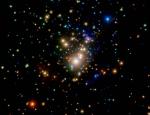 X Ray Stars of Orion
6.10.2007
The stars of Orion shine brightly in visible light in planet Earth's night sky. The constellation harbors the closest large stellar nursery, the Great Nebula of Orion, a mere 1,500 light-years away.
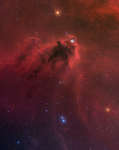 LDN 1622: Dark Nebula in Orion
20.02.2020
The silhouette of an intriguing dark nebula inhabits this cosmic scene. Lynds' Dark Nebula (LDN) 1622 appears against a faint background of glowing hydrogen gas only visible in long telescopic exposures of the region. In contrast, the brighter reflection nebula vdB 62 is more easily seen, just above and right of center.
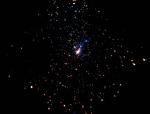 X Ray Stars in the Orion Nebula
19.05.2005
When our middle-aged Sun was just a few million years old it was thousands of times brighter in x-rays. In fact, it was likely similar to some of the stars found in this false-color x-ray composite of the Orion Nebula region from the Chandra Observatory.
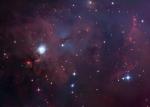 NGC 1999: South of Orion
29.01.2006
South of the large star-forming region known as the Orion Nebula, lies bright blue reflection nebula NGC 1999. The nebula is marked with a dark inverted T-shape at the lower left in a broad cosmic vista that spans over 10 light-years.
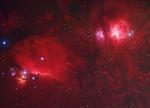 An Orion Deep Field
14.01.2004
Adrift 1,500 light-years away in one of the night sky's most recognizable constellations, the glowing Orion Nebula and the dark Horsehead Nebula are contrasting cosmic vistas. They both appear in this stunning composite digital image assembled from over 20 hours of data that includes exposures filtered to record emission from hydrogen atoms.
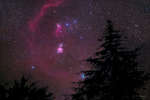 Orion Pines
15.04.2022
Taken with a camera fixed to a tripod, many short exposures were aligned with the stars to unveil this beautiful, dark night sky. Captured near the rural village of Albany`a at the northeastern corner of Spain, the three stars of Orion's belt stretch across top center in the starry frame.
|
January February March April May June July August September |
|||||||||||||||||||||||||||||||||||||||||||||||||