
|
You entered: comet
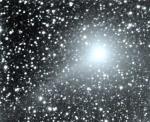 Comet Williams in 1998
6.10.1998
The brightest comet in the sky right now is Comet Williams. Moving slowly though the constellation of Centaurus, Comet Williams, at magnitude 8, is visible to Southern Hemisphere observers with binoculars. In ten days...
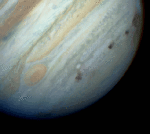 Comet Impacts on Jupiter
14.07.1995
In July of 1994, pieces of Comet Shoemaker-Levy 9, also known as the "string of pearls" comet, collided with the planet Jupiter. As the comet fragments smashed in to Jupiter, the resulting explosions scattered large quantities of dusty cometary debris into the Jovian atmosphere.
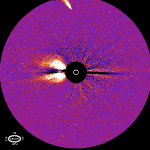 Comet Hyakutake and a Solar Flare
17.05.1996
A rare coincidence was recently captured by the orbiting SOHO spacecraft. During the closest approach to the Sun of Comet Hyakutake on May 1, SOHO photographed the comet. By accident -- during the time this photograph was being taken -- a solar flare was being ejected from the Sun.
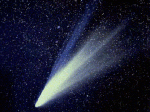 Two Tails of Comet West
26.08.1995
Here Comet West is seen showing two enormous tails that wrap around the sky. The ion tale of a comet usually appears more blue and always points away from the Sun. The dust tail trailing the comet's nucleus is the most prominent.
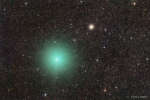 The Comet and the Star Cluster
11.04.2016
Comet Linear has become unexpectedly bright. The comet, discovered in 2000, underwent a 100-fold outburst just a week before it passed a mere 14 lunar distances from Earth late last month. The comet...
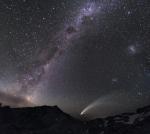 Three Galaxies and a Comet
30.03.2007
Diffuse starlight and dark nebulae along the southern Milky Way arc over the horizon and sprawl diagonally through this gorgeous nightscape. The breath-taking mosaic spans a wide 100 degrees, with the rugged terrain of the Patagonia, Argentina region in the foreground.
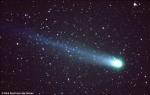 Hyakutake: Stars Through A Comet Tail
17.07.1998
Comets are cosmic icebergs. They follow very elongated orbits which carry them from the frozen, remote outer reaches of the Solar System to close encounters with the Sun. Heated by sunlight, they slough off layers of material as gas and dust, forming their characteristic awe-inspiring comas (heads) and tails.
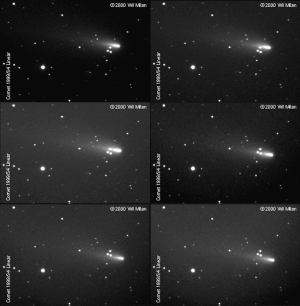 Comet LINEAR Approaches
4.07.2000
Just possibly, a new comet may become bright enough to see without binoculars later this month. Comet C/1999 S4 LINEAR is rapidly approaching both the Earth and the Sun from the outer Solar System, and should be at its brightest around 2000 July 25 in the early evening sky of northern observers.
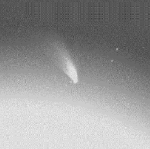 Comet Hyakutake Passes the Sun
16.05.1996
On May 1, Comet Hyakutake made its closest approach to the Sun. During this time it was not possible to view the comet with most astronomical instruments because of the brightness of the nearby Sun.
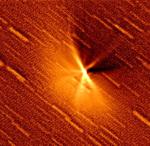 More Jets from Comet Hale-Bopp
13.02.1997
Comets become fountains of gas and dust as they get near the Sun. Solar heat vaporizes the outer layers of these spectacular orbiting icebergs, exposing caverns of pressurized gas that erupt into jets. The above digitally enhanced image of Comet Hale-Bopp was taken on January 29th and highlights several of these dust jets.
|
January February March April May June July August September |
|||||||||||||||||||||||||||||||||||||||||||||||||