
|
You entered: rings
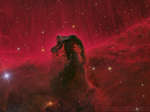 The Horsehead Nebula
17.12.2019
Sculpted by stellar winds and radiation, a magnificent interstellar dust cloud by chance has assumed this recognizable shape. Fittingly named the Horsehead Nebula, it is some 1,500 light-years distant, embedded in the vast Orion cloud complex.
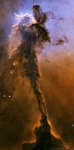 The Fairy of Eagle Nebula
25.09.2022
The dust sculptures of the Eagle Nebula are evaporating. As powerful starlight whittles away these cool cosmic mountains, the statuesque pillars that remain might be imagined as mythical beasts. Featured here is one of several striking dust pillars of the Eagle Nebula that might be described as a gigantic alien fairy.
 Galactic Cirrus: Mandel Wilson 9
21.07.2023
The combined light of stars along the Milky Way are reflected by these cosmic dust clouds that soar 300 light-years or so above the plane of our galaxy. Known to some as integrated flux nebulae and commonly found at high galactic latitudes, the dusty galactic cirrus clouds are faint.
 APOD: 2024 September 2 Б A Triangular Prominence Hovers Over the Sun
2.09.2024
Why is there a triangle hovering over the Sun? Although the shape is unusual, the type of structure is not: it is part of an evolving solar prominence. Looping magnetic fields on the Sun channel the flow of energetic particles, sometimes holding glowing gaseous structures aloft for months.
 APOD: 2025 April 7 Б NGC 4414: A Flocculent Spiral Galaxy
7.04.2025
How much mass do flocculent spirals hide? The featured image of flocculent spiral galaxy NGC 4414 was taken with the Hubble Space Telescope to help answer this question. Flocculent spirals -- galaxies without well-defined spiral arms -- are a quite common form of galaxy, and NGC 4414 is one of the closest.
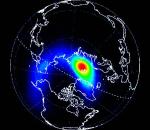 X-Ray Earth
16.09.2000
Above is a picture of the Earth in x-rays, taken in March of 1996 from the orbiting Polar satellite. Most of the planet is dark with superposed continent and coordinate grids, while the bright x-ray emission near the north pole is shown in red. Why does the Earth have an x-ray glow?
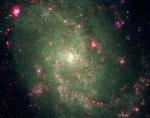 Elements of Nearby Spiral M33
27.09.2001
Spiral galaxy M33 is a mid-sized member of our Local Group of Galaxies. M33 is also called the Triangulum Galaxy for the constellation in which it resides. About four times smaller (in radius) than...
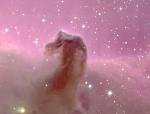 The Horsehead Nebula
16.12.2001
One of the most identifiable nebulae in the sky, the Horsehead Nebula in Orion, is part of a large, dark, molecular cloud. Also known as Barnard 33, the unusual shape was first discovered on a photographic plate in the late 1800s.
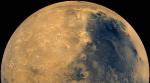 Mars: Just The Fiction
28.05.1997
For centuries, astronomers have observed Mars, patiently compiling many facts and theories. Like a distant mirror of Earth dwellers' hopes and fears for the future, Mars, the fourth planet from the sun, has inspired profound works of fiction as well.
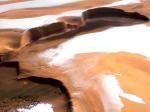 Steep Cliffs on Mars
15.03.2005
Vertical cliffs of nearly two kilometers occur near the North Pole of Mars. Also visible in the above image of the Martian North Polar Cap are red areas of rock and sand, white areas of ice, and dark areas of unknown composition but hypothesized to be volcanic ash.
|
January February March April May |
|||||||||||||||||||||||||||||||||||||||||||||||||