
|
You entered: rings
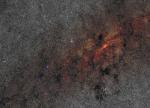 The Galactic Center in Infrared
16.07.2006
The center of our Galaxy is a busy place. In visible light, much of the Galactic Center is obscured by opaque dust. In infrared light, however, dust glows more and obscures less, allowing nearly one million stars to be recorded in the above photograph.
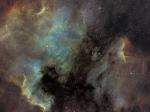 The North America and Pelican Nebulas
16.08.2006
Here are some familiar shapes in unfamiliar locations. This emission nebula on the left is famous partly because it resembles Earth's continent of North America. To the right of the North America Nebula, cataloged as NGC 7000, is a less luminous nebula that resembles a pelican dubbed the Pelican Nebula.
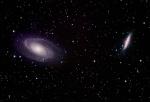 Galaxy Wars: M81 Versus M82
8.02.2000
In the left corner, wearing a red nucleus surrounded by blue spiral arms, is M81. In the right corner, sporting light stars and dark dust lanes, is M82. These two mammoth galaxies have been locked in gravitational combat for the past billion years.
 Will the Universe End in a Big Rip
21.10.2007
How will our universe end? Recent speculation now includes a pervasive growing field of mysterious repulsive phantom energy that rips virtually everything apart. Although the universe started with a Big Bang, analysis of cosmological measurements allows a possibility that it will end with a Big Rip.
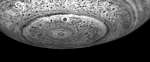 Beneath the South Pole of Saturn
26.10.2008
What clouds lurk beneath Saturn's unusual South Pole? To help find out, the robotic Cassini spacecraft currently orbiting Saturn imaged the nether region of the gigantic ringed orb in infrared light. There thick...
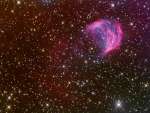 The Medusa Nebula
12.06.2010
Braided, serpentine filaments of glowing gas suggest this nebula's popular name, The Medusa Nebula. Also known as Abell 21, this Medusa is an old planetary nebula some 1,500 light-years away in the constellation Gemini. Like its mythological namesake, the nebula is associated with a dramatic transformation.
 APOD is 15 Years Old Today
16.06.2010
Welcome to the quindecennial year of the Astronomy Picture of the Day! Perhaps a source of web consistency for some, APOD is still here. As during each of the 15 years of selecting images...
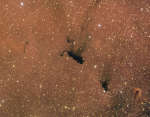 Molecular Cloud Barnard 163
1.05.2011
It may look to some like a duck, but it lays stars instead of eggs. In the center of the above image lies Barnard 163, a nebula of molecular gas and dust so thick that visible light can't shine through it.
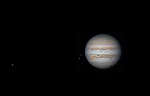 Jupiter s Triple Shadow Transit
2.11.2013
This webcam and telescope image of banded gas giant Jupiter shows the transit of three shadows cast by Jupiter's moons in progress, captured in Belgian skies on October 12 at 0528 UT. Such a three shadow transit is a relatively rare event, even for a large planet with many moons.
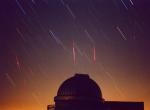 2001 Leonids: Meteors in Perspective
6.11.2002
The 2001 Leonid storm was so intense that the meteor shower's radiant, the point on the sky from which the fleeting trails seemed to diverge, was easy to spot. But the bits of debris that created the meteors really moved along parallel paths, following the orbit of their parent comet Tempel-Tuttle.
|
January February March April May |
|||||||||||||||||||||||||||||||||||||||||||||||||