
|
You entered: color
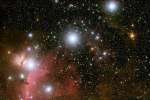 Orion s Belt
10.02.2009
Alnitak, Alnilam, and Mintaka, are the bright bluish stars from east to west (left to right) along the diagonal in this gorgeous cosmic vista. Otherwise known as the Belt of Orion, these three blue supergiant stars are hotter and much more massive than the Sun.
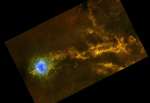 Herschel s Cocoon
19.08.2011
In this remarkable infrared skyscape of interstellar clouds adrift in the high flying constellation Cygnus, the eye is drawn to the Cocoon Nebula. Also known as IC5146, the dusty star forming region is shown...
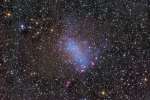 NGC 6822: Barnard s Galaxy
8.02.2013
Grand spiral galaxies often seem to get all the glory, flaunting their young, bright, blue star clusters in beautiful, symmetric spiral arms. But small galaxies form stars too, like nearby NGC 6822, also known as Barnard's Galaxy.
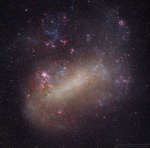 The Large Cloud of Magellan
28.05.2013
The 16th century Portuguese navigator Ferdinand Magellan and his crew had plenty of time to study the southern sky during the first circumnavigation of planet Earth. As a result, two fuzzy cloud-like objects easily...
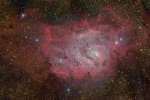 M8: The Lagoon Nebula
17.08.2013
This beautiful cosmic cloud is a popular stop on telescopic tours of the constellation Sagittarius. Eighteenth century cosmic tourist Charles Messier cataloged the bright nebula as M8. Modern day astronomers recognize the Lagoon Nebula as an active stellar nursery about 5,000 light-years distant, in the direction of the center of our Milky Way Galaxy.
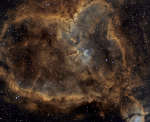 IC 1805: Light from the Heart
14.02.2014
Sprawling across almost 200 light-years, emission nebula IC 1805 is a mix of glowing interstellar gas and dark dust clouds about 7,500 light-years away in the Perseus spiral arm of our galaxy. Stars were born in this region whose nickname, the Heart Nebula, derives from its Valentine's-Day-appropriate shape.
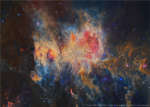 Infrared Orion from WISE
18.01.2015
The Great Nebula in Orion is an intriguing place. Visible to the unaided eye, it appears as a small fuzzy patch in the constellation of Orion. But this image, an illusory-color four-panel mosaic taken...
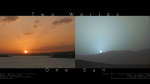 Two Worlds One Sun
12.05.2015
How different does sunset appear from Mars than from Earth? For comparison, two images of our common star were taken at sunset, one from Earth and one from Mars. These images were scaled to have same angular width and featured here side-by-side.
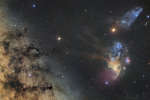 Saturn and Mars visit Milky Way Star Clouds
10.05.2016
Planets, stars, nebulas and a galaxy -- this impressive image has them all. Closest to home are the two planets Mars (right) and Saturn (center), visible as the two bright orange spots in the upper half of the featured image.
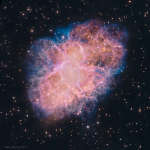 M1: The Crab Nebula
24.12.2021
The Crab Nebula is cataloged as M1, the first object on Charles Messier's famous 18th century list of things which are not comets. In fact, the Crab is now known to be a supernova remnant, debris from the death explosion of a massive star, witnessed by astronomers in the year 1054.
|
January February |
|||||||||||||||||||||||||||||||||||||||||||||||||