
|
You entered: star
 APOD: 2025 December 17 Б W5: The Soul Nebula
17.12.2025
Stars are forming in the Soul of the Queen of Aethopia. More specifically, a large star forming region called the Soul Nebula can be found in the direction of the constellation Cassiopeia, whom Greek mythology credits as the vain wife of a King who long ago ruled lands surrounding the upper Nile river.
 APOD: 2026 May 25 Б Thackerays Globules
25.05.2026
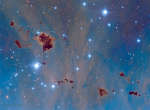
What are these strange space globs? Situated in rich star fields and glowing hydrogen gas, these opaque clouds of interstellar dust and gas are so large they might be able to form stars. Their...
 M51: The Center Of The Whirlpool
27.05.2000
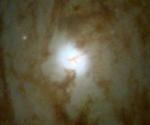
In the center of M51, a spiral galaxy 23 million light-years away, astronomers have identified a dense region of young stars. Viewed face-on in the constellation Canes Venatici, the swirling arcs of this galaxy's spiral arms have inspired its popular name, The Whirlpool Galaxy.
 M31: The Andromeda Galaxy
26.11.2006
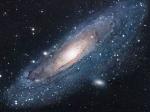
Andromeda is the nearest major galaxy to our own Milky Way Galaxy. Our Galaxy is thought to look much like Andromeda. Together these two galaxies dominate the Local Group of galaxies. The diffuse light from Andromeda is caused by the hundreds of billions of stars that compose it.
 Summer Night in Astronomy Town
12.09.2009
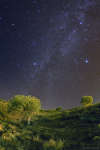
This serene view records a late summer night sky over the rolling, green hills of planet Earth. It was taken near the rural village of Saadat Shahr, Fars province, in southern Iran. Saadat Shahr is also known as Astronomy Town, as the inhabitants have demonstrated a remarakble passion for sky gazing.
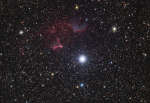 Gamma Cas and Friends
24.12.2009
Gamma Cassiopeiae shines high in northern autumn evening skies. The brightest spiky star in this rich and colorful Milky Way starfield, bluish Gamma Cas marks the central peak in the W-shaped constellation Cassiopeia.
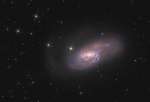 Spiral Galaxy M66
13.11.2010
Big beautiful spiral galaxy M66 lies a mere 35 million light-years away. About 100 thousand light-years across, the gorgeous island universe is well known to astronomers as a member of the Leo Triplet of galaxies.
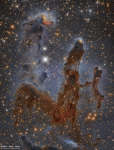 Pillars of the Eagle Nebula in Infrared
7.03.2021
Newborn stars are forming in the Eagle Nebula. Gravitationally contracting in pillars of dense gas and dust, the intense radiation of these newly-formed bright stars is causing surrounding material to boil away. This image...
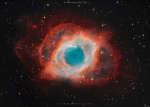 NGC 7293: The Helix Nebula
7.12.2022
A mere seven hundred light years from Earth, toward the constellation Aquarius, a sun-like star is dying. The dying star's last few thousand years have produced the Helix Nebula (NGC 7293), a well studied and nearby example of a Planetary Nebula, typical of this final phase of stellar evolution.
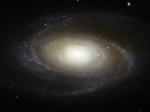 Bright Spiral Galaxy M81 from Hubble
29.05.2007
The Hubble Space Telescope has resolved individual stars in a spectacular new image of nearby spiral galaxy M81. The feat is similar to Edwin Hubble's historic images with the Mt. Wilson 100-inch Hooker Telescope in the 1920s that resolved stars in neighboring galaxy M31.
|
January February March April May June July August September |
|||||||||||||||||||||||||||||||||||||||||||||||||