
|
You entered: star
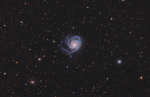 A View Toward M101
15.03.2019
Big, beautiful spiral galaxy M101 is one of the last entries in Charles Messier's famous catalog, but definitely not one of the least. About 170,000 light-years across, this galaxy is enormous, almost twice the size of our own Milky Way galaxy.
 M81 in True Color
14.07.1996
Here's what a spiral galaxy REALLY looks like. Yesterday, M81 was shown in two colors only, but here we see M81 at its most colorful. In the above picture, note how blue the spiral arms are - this indicates the presence of hot young stars and on-going star formation.
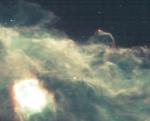 Infrared Horsehead
6.08.1998
This famous cosmic dust cloud was imaged in infrared light by the European Space Agency's Infrared Space Observatory (ISO) satellite. The false-color picture shows the bright infrared emission from dust and molecular gas in part of the Orion star forming region surrounding the Horsehead Nebula.
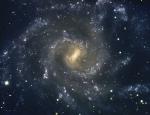 The Arms of NGC 7424
16.12.2004
The grand, winding arms are almost mesmerizing in this face-on view of NGC 7424, a spiral galaxy with a prominent central bar. About 40 million light-years distant in the headlong constellation Grus, this island universe is also about 100,000 light-years across making it remarkably similar to our own Milky Way.
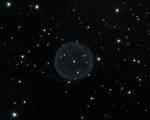 Spherical Planetary Nebula Abell 39
28.07.2005
Ghostly in appearance, Abell 39 is a remarkably simple, spherical nebula about five light-years across. Well within our own Milky Way galaxy, the cosmic sphere is roughly 7,000 light-years distant toward the constellation Hercules.
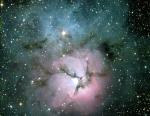 M20: The Trifid Nebula
28.03.2000
Unspeakable beauty and unimaginable bedlam can be found together in the Trifid Nebula. Also known as M20, this photogenic nebula is visible with good binoculars towards the constellation of Sagittarius. The energetic processes of star formation create not only the colors but the chaos. The red-glowing gas results from high-energy starlight striking interstellar hydrogen gas.
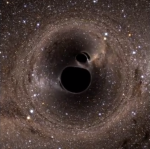 When Black Holes Collide
11.04.2021
What happens when two black holes collide? This extreme scenario occurs in the centers of many merging galaxies and multiple star systems. The featured video shows a computer animation of the final stages of such a merger, while highlighting the gravitational lensing effects that would appear on a background starfield.
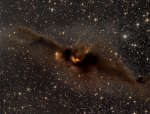 LDN 43: The Cosmic Bat Nebula
31.10.2022
What is the most spook-tacular nebula in the galaxy? One contender is LDN 43, which bears an astonishing resemblance to a vast cosmic bat flying amongst the stars on a dark Halloween night. Located...
 APOD: 2025 July 31 Б Supernova 2025rbs in NGC 7331
31.07.2025
A long time ago in a galaxy 50 million light-years away, a star exploded. Light from that supernova was first detected by telescopes on planet Earth on July 14th though, and the extragalactic transient is now known to astronomers as supernova 2025rbs.
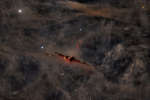 APOD: 2026 July 9 Б The Red Glow of the Cosmic Bat Nebula
9.07.2026
This Cosmic Bat wishes you a happy Summerween! This mid-year celebration of Halloween transcends hemispheres, even though summer in the Northern hemisphere is winter in the South. Contrary to its eery aura, the Cosmic Bat Nebula (LDN 43), not to be confused with the Bat Nebula (NGC 6995), is a vibrant birthplace for stars.
|
January February March April May June July August September |
|||||||||||||||||||||||||||||||||||||||||||||||||