
|
You entered: Earth
 Pickering s Triangle in the Veil
16.09.2015
Chaotic in appearance, these filaments of shocked, glowing gas break across planet Earth's sky toward the constellation of Cygnus, as part of the Veil Nebula. The Veil Nebula itself is a large supernova remnant, an expanding cloud born of the death explosion of a massive star.
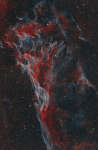 Williamina Fleming s Triangular Wisp
9.11.2017
Chaotic in appearance, these tangled filaments of shocked, glowing gas are spread across planet Earth's sky toward the constellation of Cygnus as part of the Veil Nebula. The Veil Nebula itself is a large supernova remnant, an expanding cloud born of the death explosion of a massive star.
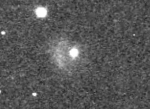 Expanding Plume from DARTs Impact
4.10.2022
What happens if you crash a spaceship into an asteroid? In the case of NASA's DART spaceship and the small asteroid Dimorphos, as happened last week, you get quite a plume. The goal...
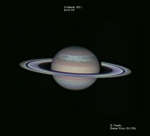 Saturn s Serpent Storm
16.03.2011
Late last year, a new, remarkably bright storm erupted in Saturn's northern hemisphere. Nicknamed "the Serpent Storm", the northern hemisphere disturbance is still going strong and now circles far around the planet. Offering...
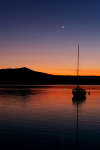 Conjunction at Sunset
29.12.2011
While Comet Lovejoy entertained early morning risers in in the southern hemisphere, a lovely conjunction of a young crescent Moon and Venus graced western skies at sunset. Captured on December 26th the conjunction, with beautiful sunset colors above and below, is seen here over Viverone Lake near Turin, Italy.
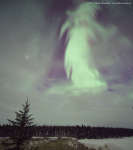 Ghost Aurora over Canada
30.10.2016
What does this aurora look like to you? While braving the cold to watch the skies above northern Canada early one morning in 2013, a most unusual aurora appeared. The aurora definitely appeared to be shaped like something , but what?
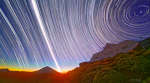 APOD: 2026 March 20 Б Spring Equinox at Teide Observatory
19.03.2026
The defining astronomical moment of the equinox today is at 14:46 UTC (March 20). That's when the Sun crosses the celestial equator moving north in its yearly journey through planet Earth's sky, marking the beginning of spring for our fair planet in the northern hemisphere and fall in the southern hemisphere.
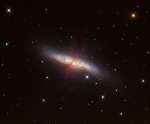 Bright Supernova in M82
24.01.2014
Astronomers really don't find supernovae by looking for the arrows. But in this image taken January 23rd, an arrow does point to an exciting, new supernova, now cataloged as SN 2014J, in nearby bright galaxy M82.
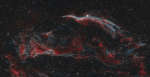 Along the Western Veil
5.09.2018
Delicate in appearance, these filaments of shocked, glowing gas, are draped across planet Earth's sky toward the constellation of Cygnus. They form the western part of the Veil Nebula. The Veil Nebula itself is a large supernova remnant, an expanding cloud born of the death explosion of a massive star.
 Along the Western Veil
4.04.2014
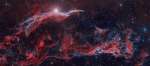
Delicate in appearance, these filaments of shocked, glowing gas, draped in planet Earth's sky toward the constellation of Cygnus, make up the western part of the Veil Nebula. The Veil Nebula itself is a large supernova remnant, an expanding cloud born of the death explosion of a massive star.
|
January February March April May June July August September October |
|||||||||||||||||||||||||||||||||||||||||||||||||