
|
You entered: sky
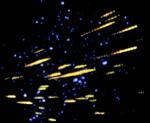 Meteors Now and Again
10.08.1998
The Perseid Meteor Shower, usually the best meteor shower of the year, will peak over the next two nights. Over the course of an hour, a person watching a clear sky from a dark location might see as many as 100 meteors.
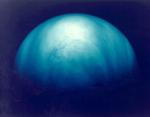 Venus: Just Passing By
25.06.2005
Venus, the second closest planet to the Sun, is by far the brightest of the three planets gathered in this weekend's western sky at sunset. It has also proven to be a popular way-point for spacecraft headed for the gas giant planets in the outer reaches of the solar system. Why visit Venus first?
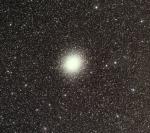 Omega Centauri
26.05.2006
Centaurus, the Centaur, is one of the most striking constellations in the southern sky. The Milky Way flows through this celestial expanse whose wonders also include the closest star to the sun, Alpha Centauri, and the largest globular star cluster in our galaxy, Omega Centauri.
 Gemini South Star Trails
1.09.2006
Stars seem to arc through southern skies in this surrealistic time exposure -- recorded before moonrise from the Gemini South Observatory, Cerro Pachon, Chile, Planet Earth. During the one hour 40 minute exposure camera and tripod were fixed, so the concentric star trails are a reflection of Earth's daily rotation about its axis.
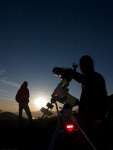 Star Party on Planet Earth
4.04.2009
As twilight sweeps around planet Earth tonight (April 4), many amateur astronomers will set up their telescopes for a 24-hour global star party. The planetwide star party is part of 100 Hours of Astronomy (100HA), a project of the International Year of Astronomy 2009.
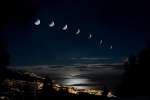 Eclipse at Moonset
28.12.2010
Hugging the horizon, a dark red Moon greeted early morning skygazers in eastern Atlantic regions on December 21, as the total phase of 2010's Solstice Lunar Eclipse began near moonset. This well composed...
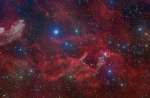 NGC 1788 and the Witch s Whiskers
19.04.2013
This skyscape finds an esthetic balance of interstellar dust and gas residing in the suburbs of the nebula rich constellation of Orion. Reflecting the light of bright star Rigel, Beta Orionis, the jutting, bluish chin of the Witch Head Nebula is at the upper left.
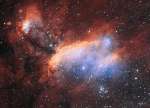 IC 4628: The Prawn Nebula
23.09.2013
South of Antares, in the tail of the nebula-rich constellation Scorpius, lies emission nebula IC 4628. Nearby hot, massive stars, millions of years young, radiate the nebula with invisible ultraviolet light, stripping electrons from atoms. The electrons eventually recombine with the atoms to produce the visible nebular glow, dominated by the red emission of hydrogen.
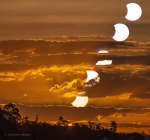 Brisbane Sunset Moonset
1.05.2014
In skies over Brisbane at the southeastern corner of Queensland, Australia, Planet Earth, the Sun and New Moon set together on April 29. There the celestial line-up, the first solar eclipse of 2014, was seen as a partial solar eclipse.
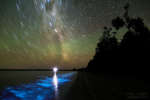 A Luminous Night
9.08.2014
What shines in the world at night? Just visible to the eye, a rare electric blue glow spread along the shores of Victoria Lake on January 16, 2013. Against reflections of a light near the horizon, this digitally stacked long exposure recorded the bioluminescence of noctiluca scintillans, plankton stimulated by the lapping waves.
|
January February March April May June July August September October |
|||||||||||||||||||||||||||||||||||||||||||||||||