
|
You entered: sky
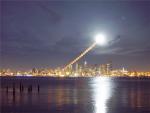 Moonrise Over Seattle
30.01.2002
Is the Moon larger when near the horizon? No -- as shown above, the Moon appears to be very nearly the same size no matter its location on the sky. Oddly, the cause or causes for the common Moon Illusion are still being debated.
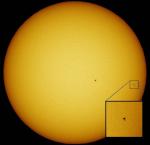 ISS and Discovery Transit the Sun
29.07.2005
That large sunspot near the right edge of the Sun is actually not a sunspot at all. It's the International Space Station (ISS) docked with the Space Shuttle Discovery on mission STS-114.
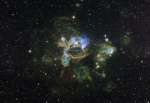 The N44 Complex
27.03.2008
A truly giant complex of emission nebulae, N44 is about 1,000 light-years across. It shines in southern skies as a denizen of our neighboring galaxy, the Large Magellanic Cloud, 170,000 light-years away.
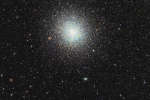 47 Tuc: A Great Globular Cluster of Stars
26.08.2008
Stars come in bunches. Of the over 200 globular star clusters that orbit the center of our Milky Way Galaxy, 47 Tucanae is the second brightest globular cluster (behind Omega Centauri). Light takes about...
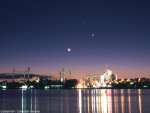 Planets over Perth
12.09.2008
A bright trio of terrestrial planets were joined by a young Moon on September 1st, in planet Earth's early evening skies. In this view of the celestial gathering from Perth, Western Australia, the Moon's sunlit crescent is nearly horizontal at Perth's southern latitude of about 32 degrees.
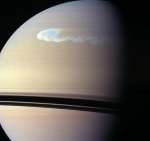 Saturn Storm
19.01.2011
Late last year, a new, remarkably bright storm erupted in Saturn's northern hemisphere. Amateur astronomers first spotted it in early December, with the ringed gas giant rising in planet Earth's predawn sky.
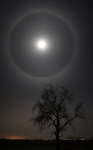 A February Moon Halo
11.02.2012
Lighting the night last Tuesday, February's Full Moon is sometimes called the Snow Moon. But the Moon was not quite full in this mosaicked skyscape recorded on February 2 south of Budapest, Hungary, and there was no snow either.
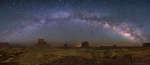 The Milky Way Over Monument Valley
1.08.2012
You don't have to be at Monument Valley to see the Milky Way arch across the sky like this -- but it helps. Only at Monument Valley USA would you see a picturesque foreground that includes these iconic rock peaks called buttes.
 Moons at Opposition
10.10.2014
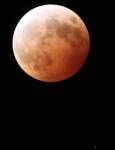
From the early hours of October 8, over the Santa Cruz Mountains near Los Gatos, California, the totally eclipsed Moon shows a range of color across this well-exposed telescopic view of the lunar eclipse.
 Volcano of Fire Erupts Under the Stars
10.03.2015
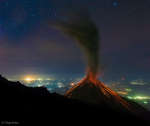
First, there was an unusual smell. Then there was a loud bang. But what appeared to the eye was the most amazing of all. While waiting near midnight to see a possible eruption of VolcАn de Fuego (Volcano of Fire) in Guatemala last month, a ready camera captured this extraordinary image.
|
January February March April May June July August September October |
|||||||||||||||||||||||||||||||||||||||||||||||||