
|
You entered: planet
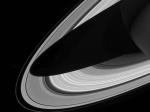 A Shadow on the Rings of Saturn
21.07.2004
This picture of Saturn could not have been taken from Earth. No Earth based picture could possibly view the night side of Saturn and the corresponding shadow cast across Saturn's rings. Since Earth is much closer to the Sun than Saturn, only the day side of the planet is visible from the Earth.
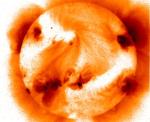 Perihelion Sun
10.01.1999
The Earth's orbit is not a perfect, sun-centered circle. At aphelion, the most distant point in Earth's orbit, the Sun is 150 million kilometers away and at perihelion, the closest point, Earth approaches the Sun to within about 147 million kilometers. While aphelion occurs in July, perihelion for planet Earth comes in January.
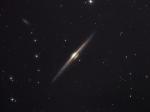 NGC 4565: Galaxy on the Edge
8.07.2005
Magnificent spiral galaxy NGC 4565 is viewed edge-on from planet Earth. Also known as the Needle Galaxy for its narrow profile, bright NGC 4565 is a stop on many telescopic tours of the northern sky as it lies in the faint but well-groomed constellation Coma Berenices.
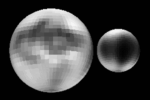 Mysterious Pluto and Charon
9.04.2000
Pluto is the only planet in our Solar System remaining unphotographed by a passing spacecraft. Distant Pluto and its moon Charon therefore remain somewhat mysterious. In addition to direct imaging by the Hubble Space...
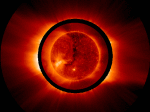 A Wind From The Sun
17.03.2000
A wind from the Sun blows through our Solar System. The behaviour of comet tails as they flapped and waved in this interplanetary breeze gave astronomers the first hint of its existence. Streaming outward at 250-400 miles/second, electrons and ions boiling off the Sun's incredibly hot
 Mountains of Titan
13.12.2006
Peering through the thick, hazy atmosphere of Saturn's largest moon, an infrared camera onboard the Cassini spacecraft recorded this view of the tallest mountains ever seen on Titan. Captured during a flyby...
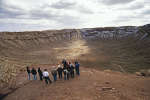 Inside Barringer Meteor Crater
11.08.2009
What happens when a meteor hits the ground? Usually nothing much, as most meteors are small, and indentations they make are soon eroded away. About 50,000 years ago, however, a large meteor created Barringer Meteor Crater in Arizona, USA. Also known simply as Meteor Crater, the resulting impact basin spans over a kilometer.
 Sunset, Shadowrise
29.07.2010
From central Australia, this serene 360 degree panorama follows a clear horizon as twilight began on May 28. At left, a bright western sky is still illuminated by the setting Sun. But sweeping right...
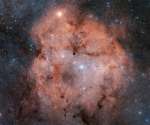 IC 1396: Emission Nebula in Cepheus
5.08.2012
Stunning emission nebula IC 1396 mixes glowing cosmic gas and dark dust clouds in the high and far off constellation of Cepheus. Energized by the bright, bluish central star seen here, this star forming region sprawls across hundreds of light-years -- spanning over three degrees on the sky while nearly 3,000 light-years from planet Earth.
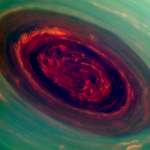 Saturn Hurricane
2.05.2013
Acquiring its first sunlit views of far northern Saturn late last year, the Cassini spacecraft's narrow-angle camera recorded this stunning image of the vortex at the ringed planet's north pole. The false...
|
January February March April May June July August September |
|||||||||||||||||||||||||||||||||||||||||||||||||