
|
You entered: planet
 Saturn in Infrared from Cassini
24.07.2022
Many details of Saturn appear clearly in infrared light. Bands of clouds show great structure, including long stretching storms. Also quite striking in infrared is the unusual hexagonal cloud pattern surrounding Saturn's North Pole. Each side of the dark hexagon spans roughly the width of our Earth.
 Moonrays of August
4.08.2023
A Full Moon rose as the Sun set on August 1. Near perigee, the closest point in its almost moonthly orbit, the brighter than average lunar disk illuminated night skies around planet Earth as the second supermoon of 2023.
 Startrails over Beijing Ancient Observatory
2.12.2023
You can take a subway ride to visit this observatory in Beijing, China but you won't find any telescopes there. Starting in the 1400s astronomers erected devices at the Beijing Ancient Observatory site to enable them to accurately measure and track the positions of naked-eye stars and planets.
 APOD: 2025 August 16 Б A Cool GIF of a 2025 Perseid
16.08.2025
The camera battery died about 2am local time on August 12, while shooting in the bright moonlit skies from a garden in Chastre, Brabant Wallon, Belgium, planet Earth. But not before it captured...
 APOD: 2025 September 5 Б 47 Tucanae: Globular Star Cluster
5.09.2025
Also known as NGC 104, 47 Tucanae is a jewel of the southern sky. Not a star but a dense cluster of stars, it roams the halo of our Milky Way Galaxy along with some 200 other globular star clusters.
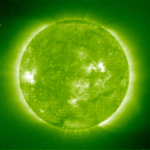 Sun and Winter Solstice 1996
21.12.1996
Today is the Winter Solstice for 1996. After steadily sinking in Northern Hemisphere skies, the Sun is now at its lowest declination - marking the first day of Northern Winter (but Southern Summer!). The Earth...
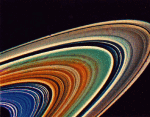 The Rings of Saturn
30.07.1995
Saturn's spectacular system of bright rings has been the subject of study and wonder since Galileo first turned his telescope on the ringed planet in 1610. To Galileo, the blurry image produced by his small telescope was confusing. Saturn appeared to him to have "ear-like" appendages which he thought might be large moons.
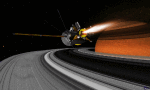 Cassini To Saturn
29.08.1997
Scheduled for launch in October, the Cassini spacecraft will spend seven years traveling through the Solar System -- its destination, Saturn. On arrival Cassini will begin an ambitious mission of exploration which will include parachuting a probe to the surface of Titan, Saturn's largest moon.
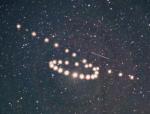 Retrograde Mars
16.12.2003
Why would Mars appear to move backwards? Most of the time, the apparent motion of Mars in Earth's sky is in one direction, slow but steady in front of the far distant stars. About every two years, however, the Earth passes Mars as they orbit around the Sun.
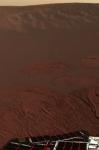 A Landing at Meridiani Planum
26.01.2004
After an interplanetary journey of nearly 300 million miles, Opportunity bounced down on the martian surface at about 9:05 pm PST Saturday, its final plunge cushioned by airbags. Now the second NASA rover...
|
January February March April May June July August September |
|||||||||||||||||||||||||||||||||||||||||||||||||