
|
You entered: nebula
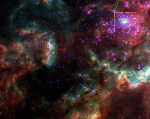 In the Center of 30 Doradus
24.05.1996
In the center of 30 Doradus lies a huge cluster of the largest, hottest, most massive stars known. The center of this cluster, known as R136, is boxed in the upper right portion of the above picture.
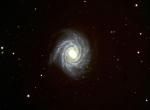 The Century that Defined Galaxy
29.12.1999
As the twentieth century dawned a debate raged over whether the Milky Way was the entire universe. The 1920s brought observations of spiral-nebulae that housed familiar but faint variable stars, and hence placed these nebulae much farther than anything else ever found. The Milky Way, apparently, is itself a spiral nebula seen from the inside.
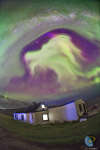 Goat Aurora Over Greenland
3.10.2012
Sometimes it's hard to believe what you see in the sky. During the Shelios Expedition to Greenland in late August, even veteran sky enthusiasts saw auroras so colorful, so fast changing, and so unusual in form that they could remember nothing like it.
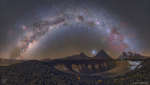 Milky Way over Chilean Volcanoes
20.08.2017
Sometimes, the sky mimics the ground. Taken in 2017 May from the Atacama Desert in Chile, the foreground of the featured image encompasses the dipping edge of the caldera of an extinct volcano. Poetically echoing the dip below is the arch of our Milky Way Galaxy above.
 The Altiplano Night
6.07.2016
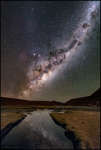
The Milky Way is massively bright on this cold, clear, altiplano night. At 4,500 meters its reflection in a river, a volcanic peak on the distant horizon, is captured in this stitched panorama under naturally dark skies of the northern Chilean highlands near San Pedro de Atacama.
 Antares and Rho Ophiuchi
9.05.2004
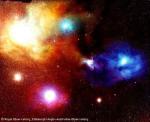
Why is the sky near Antares and Rho Ophiuchi so colorful? The colors result from a mixture of objects and processes. Fine dust illuminated from the front by starlight produces blue reflection nebulae. Gaseous clouds whose atoms are excited by ultraviolet starlight produce reddish emission nebulae. Backlit dust clouds block starlight and so appear dark.
 M64: The Sleeping Beauty Galaxy
12.06.2011
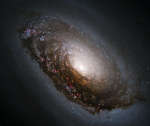
The Sleeping Beauty galaxy may appear peaceful at first sight but it is actually tossing and turning. In an unexpected twist, recent observations have shown that the gas in the outer regions of this photogenic spiral is rotating in the opposite direction from all of the stars!
 From the Temple of the Sun to the Temple of the Moon
7.10.2014
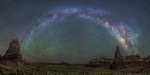
What connects the Sun to the Moon? Many answers have been given throughout history, but in the case of today's featured image, it appears to be the plane of our Milky Way Galaxy.
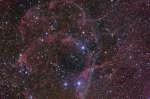 Vela Supernova Remnant
31.12.2014
The plane of our Milky Way Galaxy runs through this complex and beautiful skyscape. At the northwestern edge of the constellation Vela (the Sails) the telescopic frame is over 10 degrees wide, centered on the brightest glowing filaments of the Vela Supernova Remnant, an expanding debris cloud from the death explosion of a massive star.
 Chamaeleon I Molecular Cloud
26.05.2024
Dark markings and bright nebulae in this telescopic southern sky view are telltale signs of young stars and active star formation. They lie a mere 650 light-years away, at the boundary of the local bubble and the Chamaeleon molecular cloud complex.
|
January February |
|||||||||||||||||||||||||||||||||||||||||||||||||