
|
You entered: image
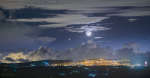 Earthshine Moon over Sicily
18.10.2021
Why can we see the entire face of this Moon? When the Moon is in a crescent phase, only part of it appears directly illuminated by the Sun. The answer is earthshine, also known as earthlight and the da Vinci glow.
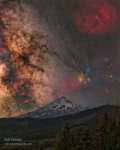 A Furious Sky over Mount Shasta
28.09.2022
Is the sky angry with Mount Shasta? According to some ancient legends, the spirits of above and below worlds fight there, sometimes quite actively during eruptions of this enormous volcano in California, USA. Such drama can well be imagined in this deep sky image taken in late June.
 APOD: 2024 September 17 Б Melotte 15 in the Heart Nebula
17.09.2024
Cosmic clouds form fantastic shapes in the central regions of emission nebula IC 1805. The clouds are sculpted by stellar winds and radiation from massive hot stars in the nebula's newborn star cluster, Melotte 15.
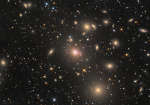 NGC 1275 in the Perseus Cluster
5.02.2026
Active galaxy NGC 1275 is the central, dominant member of the large and relatively nearby Perseus Cluster of Galaxies. Wild-looking at visible wavelengths, the active galaxy is also a prodigious source of x-rays and radio emission.
 Galaxies Of The Virgo Cluster
26.01.2001
Well over a thousand galaxies are known members of the Virgo Cluster, the closest large cluster of galaxies to our own local group. The galaxy cluster is difficult to see all at once because it covers such a large area on the sky.
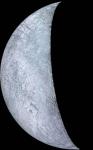 Crescent Europa
25.02.2002
Although the phase of this moon might appear familiar, the moon itself might not. In fact, this crescent shows part of Jupiter's moon Europa. The passing robot spacecraft Voyager 2 captured this image in 1979.
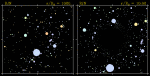 Too Close to a Black Hole
8.09.2002
What would you see if you went right up to a black hole? Above are two computer generated images highlighting how strange things would look. On the left is a normal star field containing the constellation Orion. Notice the three stars of nearly equal brightness that make up Orion's Belt.
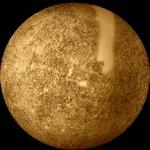 Mariner's Mercury
17.12.1996
Mercury, the closest planet to the Sun, remains the most mysterious of the Solar System's inner planets. Hiding in the Sun's glare it is a difficult target for Earth bound observers.
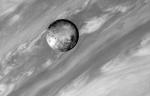 5 Million Miles From Io
11.03.1999
Twenty years ago this month, NASA's Voyager 1 spacecraft flew past Jupiter and its moons. This sharp picture of moon Io against a background of gas giant Jupiter's diffuse swirling cloud bands was recorded by Voyager's camera from a distance of about 5 million miles.
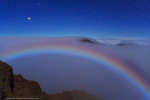 Mars and a Colorful Lunar Fog Bow
2.02.2010
Even from the top of a volcanic crater, this vista was unusual. For one reason, Mars was dazzlingly bright two weeks ago, when this picture was taken, as it was nearing its brightest time of the entire year. Mars, on the far upper left, is the brightest object in the above picture.
|
January February March April May June July August September |
|||||||||||||||||||||||||||||||||||||||||||||||||