
|
You entered: image
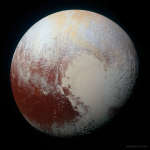 APOD: 2026 September 6 Б Pluto in Enhanced Color
6.09.2026
Pluto is more colorful than we can see. Color data and high-resolution images of our Solar System's most famous dwarf planet, taken by the robotic New Horizons spacecraft during its flyby in 2015 July, have been digitally combined to give an enhanced-color view of this ancient world sporting an unexpectedly young surface.
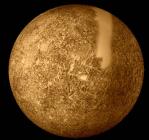 Mariner s Mercury
24.11.2001
Mercury, the closest planet to the Sun, remains the most mysterious of the Solar System's inner planets. Hiding in the Sun's glare it is a difficult target for Earth bound observers.
 The Deep Field
24.01.1996
The image above is part of the Hubble Deep Field and represents humanity's most distant yet optical view of the Universe. Galaxies like colorful pieces of candy fill the field, some as faint as 30th magnitude (about four billion times fainter than stars visible to the unaided eye).
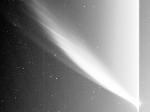 Comet McNaught from New STEREO Satellite
17.01.2007
The brightest comet of recent decades was a surprising first sight for a new camera in space. The Sun Earth Connection Coronal and Heliospheric Investigation (SECCHI) instrument onboard the Solar TErrestrial RElations Observatory (STEREO) satellite had just opened up on January 11 when it snapped the above image of Comet McNaught.
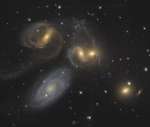 Stephan s Quintet
20.11.2010
The first identified compact galaxy group, Stephan's Quintet is featured in this eye-catching image constructed with data drawn from the extensive Hubble Legacy Archive. About 300 million light-years away, only four galaxies of the group are actually locked in a cosmic dance of repeated close encounters.
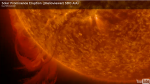 A Huge Solar Filament Erupts
15.12.2010
Click the arrow and watch an unusually long filament explode out from the Sun. The filament had been seen hovering over the Sun's surface for over a week before it erupted earlier this month.
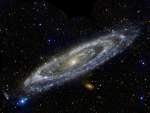 GALEX: The Andromeda Galaxy
18.05.2012
A mere 2.5 million light-years away, the Andromeda Galaxy really is just next door as large galaxy's go. So close, and spanning some 260,000 light-years, it took 11 different image fields from the Galaxy Evolution Explorer (GALEX) satellite's telescope to produce this gorgeous portrait of the spiral galaxy in ultraviolet light.
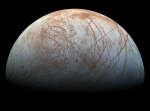 Galileo s Europa Remastered
26.11.2014
Looping through the Jovian system in the late 1990s, the Galileo spacecraft recorded stunning views of Europa and uncovered evidence that the moon's icy surface likely hides a deep, global ocean. Galileo...
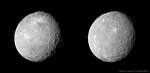 Dark Craters and Bright Spots Revealed on Asteroid Ceres
17.02.2015
What are those bright spots on asteroid Ceres? As the robotic spacecraft Dawn approaches the largest asteroid in the asteroid belt, the puzzle only deepens. Sharper new images taken last week and released yesterday...
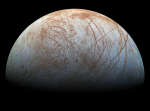 Galileo s Europa Remastered
29.11.2019
Looping through the Jovian system in the late 1990s, the Galileo spacecraft recorded stunning views of Europa and uncovered evidence that the moon's icy surface likely hides a deep, global ocean. Galileo...
|
January February March April May June July August September |
|||||||||||||||||||||||||||||||||||||||||||||||||