
|
You entered: gas
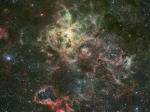 Tentacles of the Tarantula Nebula
22.08.2007
The largest, most violent star forming region known in the whole Local Group of galaxies lays in our neighboring galaxy the Large Magellanic Cloud (LMC). Were the Tarantula Nebula at the distance of the Orion Nebula -- a local star forming region -- it would take up fully half the sky.
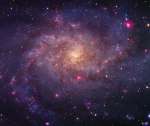 Bright Nebulae in M33
17.10.2009
Gorgeous spiral galaxy M33 seems to have more than its fair share of bright emission nebulae. In fact, narrow-band and broad-band image data are combined in this beautifully detailed composite to trace the reddish emission nebulae, star forming HII regions, sprawling along loose spiral arms that wind toward the galaxy's core.
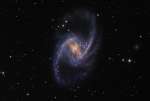 NGC 1365: Majestic Spiral with Supernova
24.11.2012
Barred spiral galaxy NGC 1365 is truly a majestic island universe some 200,000 light-years across. Located a mere 60 million light-years away toward the chemical constellation Fornax, NGC 1365 is a dominant member of the well-studied Fornax galaxy cluster.
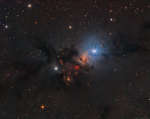 NGC 1333: Stellar Nursery in Perseus
27.03.2019
NGC 1333 is seen in visible light as a reflection nebula, dominated by bluish hues characteristic of starlight reflected by interstellar dust. A mere 1,000 light-years distant toward the heroic constellation Perseus, it lies at the edge of a large, star-forming molecular cloud.
 Grand Spiral NGC 5643
26.12.2024
Viewed face-on, grand spiral galaxy NGC 5643 has a festive appearance in this colorful cosmic portrait. Some 55 million light-years distant, the galaxy extends for over 100,000 light-years, seen within the boundaries of the southern constellation Lupus.
 APOD: 2025 January 20 Б Comet ATLAS Rounds the Sun
20.01.2025
Why does Comet ATLAS have such colorful tails? Last week Comet C/2024 G3 (ATLAS) passed its closest to the Sun -- well inside the orbit of Mercury -- and brightened dramatically. Unfortunately, the comet was then so angularly near the Sun that it was very hard for humans to see. But NASA's SOHO spacecraft saw it.
 APOD: 2025 July 19 Б Messier 6
19.07.2025
The sixth object in Charles Messier's famous catalog of things which are not comets, Messier 6 is a galactic or open star cluster. A gathering of 100 stars or so, all around 100 million years young, M6 lies some 1,600 light-years away toward the central Milky Way in the constellation Scorpius.
 X Ray Moon and X Ray Star
9.09.2000
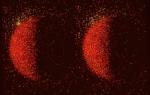
An x-ray star winks out behind the Moon in these before (left) and after views of a lunar occultation of the galactic x-ray source designated GX5-1. The false color images were made using data from the ROSAT (ROentgen SATellite), orbiting observatory.
 The Orion Nebula from VLT
30.01.2001
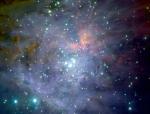
The Great Nebula in Orion is a colorful place. Visible to the unaided eye, it appears as a small fuzzy patch in the constellation of Orion. But this image, a representative-color composite...
 X-ray Moon and X-ray Star
27.02.1996
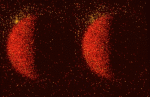
An X-ray star winks out behind the Moon in these before and after views of a lunar occultation of the galactic X-ray source designated GX5-1. The false color images were made using data...
|
January February March April May |
|||||||||||||||||||||||||||||||||||||||||||||||||