
|
You entered: gas
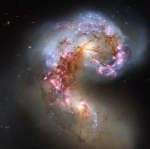 The Antennae Galaxies in Collision
3.12.2020
Sixty million light-years away toward the southerly constellation Corvus, these two large galaxies are colliding. The cosmic train wreck captured in stunning detail in this Hubble Space Telescope snapshot takes hundreds of millions of years to play out. Cataloged as NGC 4038 and NGC 4039, the galaxies' individual stars don't often collide though.
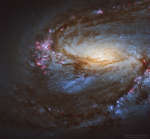 Spiral Galaxy M66 from Hubble
24.02.2021
ItБs always nice to get a new view of an old friend. This stunning Hubble Space Telescope image of nearby spiral galaxy M66 is just that. A spiral galaxy with a small central bar, M66 is a member of the Leo Galaxy Triplet, a group of three galaxies about 30 million light years from us.
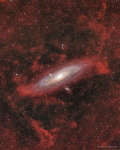 Clouds Around Galaxy Andromeda
24.10.2022
What are those red clouds surrounding the Andromeda galaxy? This galaxy, M31, is often imaged by planet Earth-based astronomers. As the nearest large spiral galaxy, it is a familiar sight with dark dust lanes, bright yellowish core, and spiral arms traced by clouds of bright blue stars.
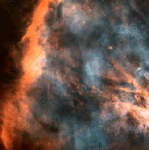 The Great Nebula in Orion
3.07.1995
The Great Nebula in Orion, M42, can be found on the night sky just below and to the left of the easily identifiable belt of three stars in the popular constellation Orion. This nebula is one of the closest stellar nurseries - where young stars are being formed even now.
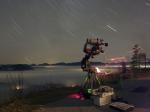 A Window to the Once Secret Sky
13.04.2005
If there was a window nearby to the distant universe -- would you look through it? Quite possibly, there is, in the form of a small telescope. A local skykeeper could be a relative or a stranger and is frequently proud to show off the sky free of charge.
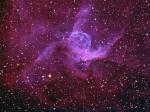 Thor s Helmet in H Alpha
2.02.2006
Near picture center, the helmet-shaped structure with wing-like appendages is popularly called Thor's Helmet. Cataloged as NGC 2359, the striking nebula is located about 15,000 light-years away in the constellation Canis Major.
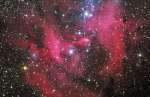 IC 2948: The Running Chicken Nebula
18.04.2008
Bright nebulae abound in and around the expansive southern constellation of Centaurus. This one, cataloged as IC 2948 is near the star Lambda Centauri and not far on the sky from the better known Eta Carinae Nebula.
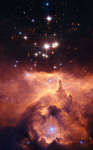 Massive Stars in Open Cluster Pismis 24
26.10.2008
How massive can a normal star be? Estimates made from distance, brightness and standard solar models had given one star in the open cluster Pismis 24 over 200 times the mass of our Sun, making it a record holder. This star is the brightest object located just above the gas front in the above image.
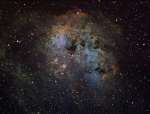 IC 410 and NGC 1893
17.01.2009
Dusty emission nebula IC 410 lies about 12,000 light-years away in the northern constellation Auriga. The cloud of glowing gas is over 100 light-years across, sculpted by stellar winds and radiation from embedded open star cluster NGC 1893.
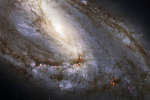 Unusual Spiral Galaxy M66 from Hubble
13.04.2010
Why isn't spiral galaxy M66 symmetric? Usually density waves of gas, dust, and newly formed stars circle a spiral galaxy's center and create a nearly symmetric galaxy. The differences between...
|
January February March April May |
|||||||||||||||||||||||||||||||||||||||||||||||||