
|
You entered: variable
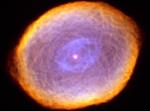 IC 418: The Spirograph Nebula
7.09.2000
What is creating the strange texture of IC 418? Dubbed the Spirograph Nebula for its resemblance to drawings from a cyclical drawing tool, planetary nebula IC 418 shows patterns that are not well understood. Perhaps they are related to chaotic winds from the variable central star, which changes brightness unpredictably in just a few hours.
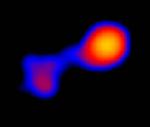 Mira: The Wonderful Star
5.05.2005
To seventeenth century astronomers, Omicron Ceti or Mira was known as a wonderful star - a star whose brightness could change dramatically in the course of about 11 months. Modern astronomers now recognize an entire class of long period Mira-type variables as cool, pulsating, red giant stars, 700 or so times the diameter of the Sun.
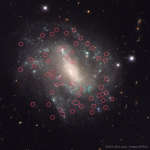 The Supernova and Cepheids of Spiral Galaxy UGC 9391
6.06.2016
What can this galaxy tell us about the expansion rate of the universe? Perhaps a lot because UGC 9391, featured, not only contains Cepheid variable stars (red circles) but also a recent Type Ia supernova (blue X).
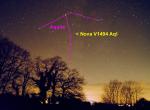 A Nova In Aquila
15.12.1999
On December 1st, experienced observers patroling the night sky with binoculars noticed what seemed to be a new star in the constellation of Aquila (The Eagle). It wasn't really a new star though.
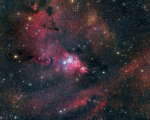 Cosmic Clouds in the Unicorn
8.02.2020
Interstellar clouds of hydrogen gas and dust abound in this gorgeous skyscape. The 3 degree wide field of view stretches through the faint but fanciful constellation Monoceros, the Unicorn. A star forming region cataloged as NGC 2264 is centered, a complex jumble of cosmic gas, dust and stars about 2,700 light-years distant.
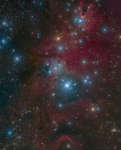 Fox Fur, a Unicorn, and a Christmas Tree
24.12.2016
Clouds of glowing hydrogen gas fill this colorful skyscape in the faint but fanciful constellation Monoceros, the Unicorn. A star forming region cataloged as NGC 2264, the complex jumble of cosmic gas and dust...
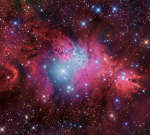 Fox Fur, Unicorn, and Christmas Tree
7.02.2019
Clouds of glowing hydrogen gas fill this colorful skyscape in the faint but fanciful constellation Monoceros, the Unicorn. A star forming region cataloged as NGC 2264, the complex jumble of cosmic gas and dust...
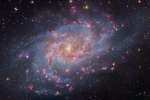 M33: The Triangulum Galaxy
3.11.2022
The small, northern constellation Triangulum harbors this magnificent face-on spiral galaxy, M33. Its popular names include the Pinwheel Galaxy or just the Triangulum Galaxy. M33 is over 50,000 light-years in diameter, third largest in the Local Group of galaxies after the Andromeda Galaxy (M31), and our own Milky Way.
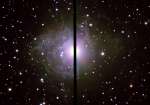 Echoes from RS Pup
12.02.2008
This dusty reflection nebula surrounds pulsating star RS Pup, some 10 times more massive than the Sun and on average 15,000 times more luminous. In fact, RS Pup is a Cepheid type variable...
 Stars and Dust Across Corona Australis
12.09.2013
Cosmic dust clouds sprawl across a rich field of stars in this sweeping telescopic vista near the northern boundary of Corona Australis, the Southern Crown. Less than 500 light-years away the dust clouds effectively block light from more distant background stars in the Milky Way.
|
January February March April May June July August September |
|||||||||||||||||||||||||||||||||||||||||||||||||