
|
You entered: variable
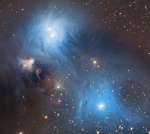 Stars and Dust in Corona Australis
18.10.2017
Blue dust clouds and young, energetic stars inhabit this telescopic vista, less than 500 light-years away toward the northern boundary of Corona Australis, the Southern Crown. The dust clouds effectively block light from more distant background stars in the Milky Way.
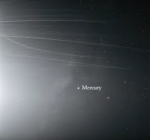 Parker: Sounds of the Solar Wind
21.01.2020
What does the solar wind sound like? A wind of fast moving particles blows out from our Sun, and although space transmits sound poorly, particle impact and variable-field data from NASA's near-Sun Parker Solar Probe is being translated into sound.
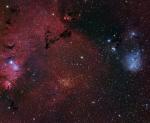 The Cone Nebula Neighborhood
12.04.2007
Cosmic clouds of hydrogen gas and dust abound in this gorgeous skyscape, stretching through Monocerous in the neighborhood of The Cone Nebula. A dark, obscuring dust cloud, the simple, sculpted shape of the Cone Nebula is near the lower left edge.
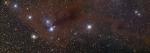 Stars and Dust Across Corona Australis
3.04.2006
A cosmic dust cloud sprawls across a rich field of stars in this gorgeous wide field telescopic vista looking toward Corona Australis, the Southern Crown. Probably less than 500 light-years away and effectively blocking...
 IC 418: The Spirograph Nebula
17.10.2004
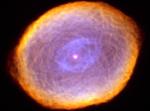
What is creating the strange texture of IC 418? Dubbed the Spirograph Nebula for its resemblance to drawings from a cyclical drawing tool, planetary nebula IC 418 shows patterns that are not well understood. Perhaps they are related to chaotic winds from the variable central star, which changes brightness unpredictably in just a few hours.
 APOD: 2023 March 28 Б A Multiple Green Flash Sunset
28.03.2023
Yes, but can your green flash do this? A green flash at sunset is a rare event that many Sun watchers pride themselvesбon having seen.б Once thought to be a myth, a green flash is now understood to occur when the Earth's atmosphere acts like both a prism and a lens.
 Pleiades to Hyades
6.12.2019
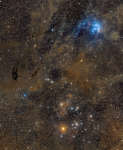
This cosmic vista stretches almost 20 degrees from top to bottom, across the dusty constellation Taurus. It begins at the Pleiades and ends at the Hyades, two star clusters recognized since antiquity in Earth's night sky. At top, the compact Pleiades star cluster is about 400 light-years away.
 Betelgeuse Imagined
1.01.2020
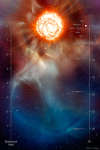
Why is Betelgeuse fading? No one knows. Betelgeuse, one of the brightest and most recognized stars in the night sky, is only half as bright as it used to be only five months ago.
 Andromeda Nebula: Var!
6.04.1996
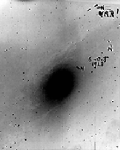
In the 1920s, using photographic plates made with the Mt. Wilson Observatory's 100 inch telescope, Edwin Hubble determined the distance to the Andromeda Nebula - decisively demonstrating the existence of other galaxies far beyond the Milky Way.
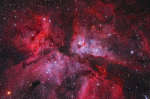 The Great Carina Nebula
15.10.2013
A jewel of the southern sky, the Great Carina Nebula, also known as NGC 3372, spans over 300 light-years, one of our galaxy's largest star forming regions. Like the smaller, more northerly Great...
|
January February March April May June July August September |
|||||||||||||||||||||||||||||||||||||||||||||||||