
|
You entered: time
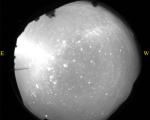 Zodiacal Light and the False Dawn
15.09.2002
An unusual triangle of light will be particularly bright near the eastern horizon before sunrise during the next two months for observers in Earth's northern hemisphere. Once considered a false dawn, this triangle of light is actually Zodiacal Light, light reflected from interplanetary dust particles.
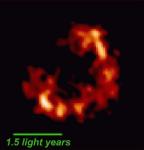 Supernova Remnant In M82
16.12.1999
This false-color radio wavelength picture of an expanding stellar debris cloud is the product of one of the largest radio astronomy experiments ever. Combining the output of 20 radio telescopes scattered around planet Earth...
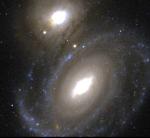 Galaxies Away
21.08.1999
This striking pair of galaxies is far, far away ... about 350 million light-years from Earth. Cataloged as AM0500-620, the pair is located in the southern constellation Dorado. The background elliptical and foreground spiral galaxy are representative of two of the three major classes of galaxies which inhabit our Universe.
 At first he couldn t see the Moon
11.04.2008
At first, he couldn't see it, but searching with binoculars along a cloudy western horizon near sunset, photographer Laurent Laveder finally spotted a delicate lunar crescent. Captured in this dramatic picture on April 6th from Bretagne, France, the Moon was only 15 hours and 38 minutes old.
 Moonrise Over Turkey
16.06.2009
Is the Moon larger when near the horizon? No -- as shown above, the Moon appears to be very nearly the same size no matter its location on the sky. Oddly, the cause or causes for the common Moon Illusion are still being debated.
 Watch Jupiter Rotate
24.01.2010
What would it be like to coast by Jupiter and watch it rotate? This was just the experience of the New Horizons spacecraft as it approached and flew by Jupiter in 2007. Clicking on the image will bring up a movie of what the robotic spacecraft saw.
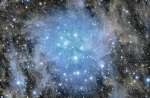 Pleiades Deep Field
21.09.2011
Have you ever seen the Pleiades star cluster? Even if you have, you probably have never seen it like this: all dusty. Perhaps the most famous star cluster on the sky, the bright stars of the Pleiades can be seen without binoculars from even the depths of a light-polluted city.
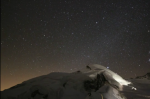 Geostationary Satellites Beyond the Alps
11.04.2012
Why don't those stars move? Stars in the sky will typically appear to rise and set as the Earth turns. Those far to the north or south will appear to circle the pole. If you look closely at the above time-lapse movie, however, there are points of light that appear stationary.
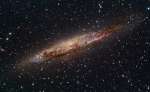 Nearby Spiral Galaxy NGC 4945
23.01.2013
Large spiral galaxy NGC 4945 is seen edge-on near the center of this cosmic galaxy portrait. In fact, NGC 4945 is almost the size of our own Milky Way Galaxy. Its own dusty disk, young blue star clusters, and pink star forming regions standout in the sharp, colorful telescopic image.
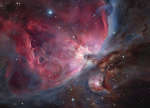 At the Heart of Orion
1.01.2015
Near the center of this sharp cosmic portrait, at the heart of the Orion Nebula, are four hot, massive stars known as the Trapezium. Tightly gathered within a region about 1.5 light-years in radius, they dominate the core of the dense Orion Nebula Star Cluster.
|
January February March April May June July August September |
|||||||||||||||||||||||||||||||||||||||||||||||||