
|
You entered: time
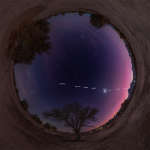 Solar System Family Portrait
29.06.2022
Yes, but have you ever seen all of the planets at once? A rare roll-call of planets has been occurring in the morning sky for much of June. The featured fisheye all-sky image, taken...
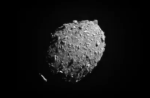 DART: Impact on Asteroid Dimorphos
27.09.2022
Could humanity deflect an asteroid headed for Earth? Yes. Deadly impacts from large asteroids have happened before in Earth's past, sometimes causing mass extinctions of life. To help protect our Earth from some...
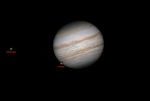 Jupiter Rotates as Moons Orbit
25.10.2022
Jupiter and its moons move like our Sun and its planets. Similarly, Jupiter spins while its moons circle around. JupiterБs rotation can be observed by tracking circulating dark belts and light zones. The Great Red Spot, the largest storm known, rotates to become visible after about 15 seconds in the 48-second time lapse video.
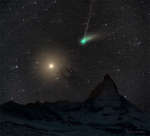 APOD: 2023 February 13 Б Comet ZTF and Mars
13.02.2023
No, Comet ZTF is not going to hit Mars. Nicknamed the Green Comet for its bright green coma, C/2022 E3 (ZTF) did, however, pass almost in front of the much-more distant planet a few days ago, very near in time to when the featured picture was taken.
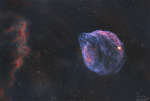 APOD: 2023 March 29 Б Sh2-308: A Dolphin Shaped Star Bubble
29.03.2023
Which star created this bubble? It wasn't the bright star on the bubble's right. And it also wasn't a giant space dolphin. It was the star in the blue nebula's center, a famously energetic Wolf-Rayet star.
 Alpha Centauri: The Closest Star System
26.05.1996
The closest star system to the Sun is the Alpha Centauri system. Of the three stars in the system, the dimmest -- called Proxima Centauri -- is actually the nearest star. The bright stars Alpha Centauri...
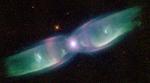 M2 9: Wings of a Butterfly Nebula
17.12.2000
Are stars better appreciated for their art after they die? Actually, stars usually create their most artistic displays as they die. In the case of low-mass stars like our Sun and M2-9 pictured above
 A Year of Dark Cosmology
31.12.2001
We live in the exciting time when humanity discovers the nature of our entire universe. During this year, in particular, however, the quest for cosmological understanding appears to have astronomers groping in the dark.
 The Perseus Cluster of Galaxies
5.04.1996
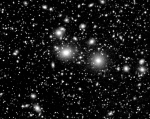
Here is one of the largest objects that anyone will ever see on the sky. Each of the fuzzy blobs in the above picture is a galaxy, together making up the Perseus Cluster, one of the closest clusters of galaxies.
 The Clouds of Neptune
7.05.1996
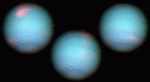
These Hubble Space Telescope (HST) images reveal glimpses of the dynamic atmosphere of Neptune, the Solar System's most distant gas giant planet. The first close-up of Neptune's clouds was provided by NASA's Voyager 2 spacecraft during its August 1989 flyby, giving a tantalizingly brief look.
|
January February March April May June July August September |
|||||||||||||||||||||||||||||||||||||||||||||||||