
|
You entered: rings
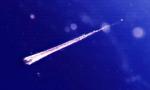 Catching Falling Stardust
1.02.1997
This carrot shaped track is actually little more than 5 hundredths of an inch long. It is the trail of a meteroid through aerogel exposed to space by the shuttle launched EURECA (European Recoverable Carrier) spacecraft.
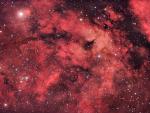 A Cygnus Star Field
28.07.2004
In the constellation of the swan near the nebula of the pelican lies the gas cloud of the butterfly surrounding a star known as the hen. That star, given the proper name Sadr, is visible to the unaided eye but found here as the brightest object on the upper left.
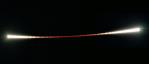 A Time Lapse Lunar Eclipse
3.11.2004
During last week's lunar eclipse, our Moon appeared to disappear. As the Earth moved between the Moon and the Sun, the Earth's shadow fell on the moon, making it quite dark.
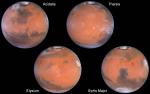 Four Faces of Mars
5.07.1999
As Mars rotates, most of its surface becomes visible. During Earth's recent pass between Mars and the Sun, the Hubble Space Telescope was able to capture the most detailed time-lapse pictures ever from the Earth. Dark and light sand and gravel create an unusual blotted appearance for the red planet.
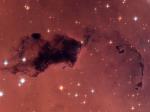 A Dust Cloud in NGC 281
20.04.2006
Stars themselves can create huge and intricate dust sculptures from the dense and dark molecular clouds from which they are born. The tools the stars use to carve their detailed works are high energy light and fast stellar winds.
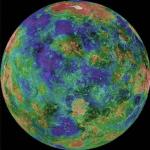 Beneath Venus Clouds
28.11.1999
If the thick clouds covering Venus were removed, how would the surface appear? Using an imaging radar technique, the Magellan spacecraft was able to lift the veil from the Face of Venus and produce this spectacular high resolution image of the planet's surface. Red, in this false-color map, represents mountains, while blue represents valleys.
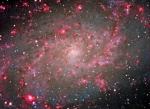 Hydrogen in M33
23.11.2006
Gorgeous spiral galaxy M33 seems to have more than its fair share of hydrogen. Its inner 30,000 light-years are shown here in an image processed to fully reveal the reddish glow of ionized hydrogen regions (HII regions) sprawling along loose spiral arms as they wind toward the galaxy's core.
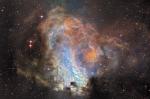 Star Factory Messier 17
10.08.2007
Sculpted by stellar winds and radiation, the star factory known as Messier 17 lies some 5,500 light-years away in the nebula-rich constellation Sagittarius. At that distance, this 30 arcminute field of view spans almost 50 light-years.
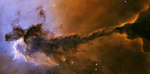 The Fairy of Eagle Nebula
9.12.2007
The dust sculptures of the Eagle Nebula are evaporating. As powerful starlight whittles away these cool cosmic mountains, the statuesque pillars that remain might be imagined as mythical beasts. Pictured above is one of several striking dust pillars of the Eagle Nebula that might be described as a gigantic alien fairy.
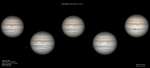 Jupiter and Io
28.11.2012
On December 3 (UT), Jupiter, the solar system's largest planet, will be at opposition, opposite the Sun in planet Earth's sky, shining brightly and rising as the Sun sets. That configuration results in Jupiter's almost annual closest approach to planet Earth.
|
January February March April May |
|||||||||||||||||||||||||||||||||||||||||||||||||