
|
You entered: rings
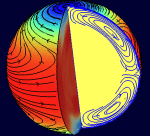 Rivers in the Sun
4.09.1997
The surface of the Sun is shifting. By watching sunspots, it has long been known that our Sun rotates. It was also known that the center of the Sun rotates faster than the poles.
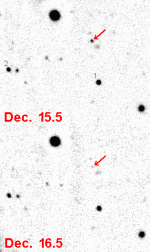 Gamma-ray Burster
18.12.1997
Gamma-ray bursts seem to be the most powerful explosions in the Universe. Yet their sources continue to elude researchers who stand in awe and frustration at the bursts' transient, enigmatic behavior. The blinking gif above illustrates the latest hard-won result in the quest to identify and understand the nature of the bursters.
 The Belt of Venus over the Valley of the Moon
21.10.2003
Although you've surely seen it, you might not have noticed it. During a cloudless twilight, just before sunrise or after sunset, part of the atmosphere above the horizon appears slightly off-color, slightly pink.
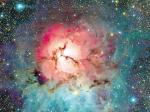 The Trifid Nebula from CFHT
31.05.2005
Unspeakable beauty and unimaginable bedlam can be found together in the Trifid Nebula. Also known as M20, this photogenic nebula is visible with good binoculars towards the constellation of Sagittarius. The energetic processes of star formation create not only the colors but the chaos. The red-glowing gas results from high-energy starlight striking interstellar hydrogen gas.
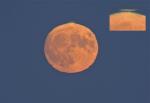 Full Moon, Green Rim
26.08.2005
July's Full Moon looks strangely darkened and distorted in this remarkable telescopic view. The image is one of a series recorded when the Moon was very near the horizon. The long sight-line through...
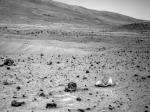 An Unusual Two Toned Rock on Mars
26.01.2006
How did this unusual Martian rock form? The atypical two-toned rock, visible in the lower right of the above image, was photographed a few days ago by the robotic Spirit rover currently rolling across Mars. For now, the environmental processes that created the rock remain a matter of speculation.
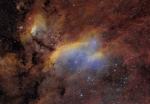 IC 4628: The Prawn Nebula
20.10.2006
South of Antares, in the tail of the nebula-rich constellation Scorpius, lies emission nebula IC 4628. Nearby hot, massive stars, millions of years young, radiate the nebula with invisible ultraviolet light, stripping electrons from atoms. The electrons eventually recombine with the atoms to produce the visible nebular glow.
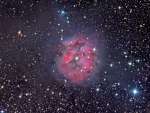 IC 5146: The Cocoon Nebula
5.03.2009
Inside the Cocoon Nebula is a newly developing cluster of stars. Cataloged as IC 5146, the beautiful nebula is nearly 15 light-years wide, located some 4,000 light years away toward the northern constellation Cygnus.
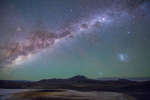 Galaxies from the Altiplano
13.10.2016
The central bulge of our Milky Way Galaxy rises over the northern Chilean Atacama altiplano in this postcard from planet Earth. At an altitude of 4500 meters, the strange beauty of the desolate landscape could almost belong to another world though.
 Finding NEOWISE
18.07.2020
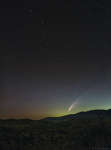
If you can see the stars of the Big Dipper, you can find comet NEOWISE in your evening sky tonight. After sunset look for the naked-eye comet below the bowl of the famous celestial kitchen utensil of the north and above your northwestern horizon.
|
January February March April May |
|||||||||||||||||||||||||||||||||||||||||||||||||