
|
You entered: dust
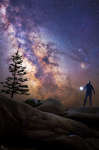 Behold the Universe
3.08.2016
What if you climbed up on a rock and discovered the Universe? You can. Although others have noted much of it before, you can locate for yourself stars, planets, and even the plane of our Milky Way Galaxy. All you need is a dark clear sky -- the rock is optional.
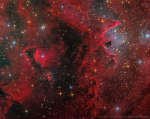 IC 1871: Inside the Soul Nebula
28.11.2018
This cosmic close-up looks deep inside the Soul Nebula. The dark and brooding dust clouds on the left, outlined by bright ridges of glowing gas, are cataloged as IC 1871. About 25 light-years across, the telescopic field of view spans only a small part of the much larger Heart and Soul nebulae.
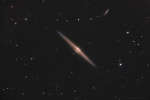 NGC 4565: Galaxy on Edge
22.02.2019
Magnificent spiral galaxy NGC 4565 is viewed edge-on from planet Earth. Also known as the Needle Galaxy for its narrow profile, bright NGC 4565 is a stop on many telescopic tours of the northern sky, in the faint but well-groomed constellation Coma Berenices.
 Utopia on Mars
21.05.2021
Expansive Utopia Planitia on Mars is strewn with rocks and boulders in this 1976 image. Constructed from the Viking 2 lander's color and black and white image data, the scene approximates the appearance of the high northern martian plain to the human eye.
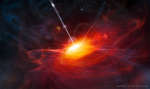 Illustration: An Early Quasar
22.02.2022
What did the first quasars look like? The nearest quasars are now known to involve supermassive black holes in the centers of active galaxies. Gas and dust that falls toward a quasar glows brightly, sometimes outglowing the entire home galaxy.
 The 37 Cluster
14.05.2024
For the mostly harmless denizens of planet Earth, the brighter stars of open cluster NGC 2169 seem to form a cosmic 37. Did you expect 42? From our perspective, the improbable numerical asterism appears solely by chance. It lies at an estimated distance of 3,300 light-years toward the constellation Orion.
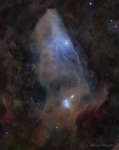 APOD: 2026 April 7 Б IC 4592: The Blue Horsehead Reflection Nebula
7.04.2026
Do you see the horse's head? What you are seeing is not the famous Horsehead nebula toward Orion, but rather a fainter nebula that only takes on a familiar form with deeper imaging. The main part of the here-imaged molecular cloud complex is reflection nebula IC 4592.
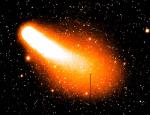 Comet Linear (WM1) Brightens
6.12.2001
A comet bright enough to be seen with binoculars is swooping into southern skies. Comet C/2000 WM1 (LINEAR) continues to brighten and develop tails as it nears its closest approach of the Sun in late January 2002.
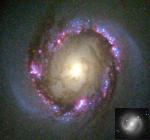 NGC 4314: A Nuclear Starburst Ring
15.06.1998
Is this old galaxy up to new tricks? The barred spiral galaxy NGC 4314 is billions of years old, but its appearance has changed markedly over just the past few millions of years. During that time, a nuclear ring of bright young stars has been evolving.
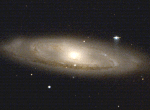 M65 Without Moth
7.08.1998
Messier 65 (M65) is a bright spiral galaxy of stars only 35 million light-years away in the constellation Leo. With very tightly wound spiral arms, a large central bulge, and well defined dust lanes, this galaxy is a member of a group of galaxies known as the Leo triplet.
|
January February March April May |
|||||||||||||||||||||||||||||||||||||||||||||||||