
|
You entered: dust
 The Great Carina Nebula
19.04.2024
A jewel of the southern sky, the Great Carina Nebula is more modestly known as NGC 3372. One of our Galaxy's largest star forming regions, it spans over 300 light-years. Like the smaller, more northerly Great Orion Nebula, the Carina Nebula is easily visible to the unaided eye.
 APOD: 2024 October 22 Б M16: Pillars of Star Creation
22.10.2024
These dark pillars may look destructive, but they are creating stars. This pillar-capturing picture of the Eagle Nebula combines visible light exposures taken with the Hubble Space Telescope with infrared images taken with the James Webb Space Telescope to highlight evaporating gaseous globules (EGGs) emerging from pillars of molecular hydrogen gas and dust.
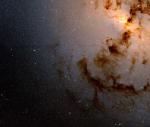 NGC 1316: After Galaxies Collide
22.02.1999
Astronomers turn detectives when trying to figure out the cause of unusual sites like NGC 1316. A preliminary inspection indicates that NGC 1316 is an enormous elliptical galaxy that started devouring a smaller spiral galaxy neighbor about 100 million years ago. Supporting evidence includes the dark dust lanes uniquely indicative of a spiral.
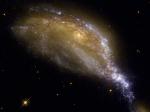 A Galaxy Collision in NGC 6745
5.11.2006
Galaxies don't normally look like this. NGC 6745 actually shows the results of two galaxies that have been colliding for only hundreds of millions of years. Just off the above photograph to the lower right is the smaller galaxy, moving away.
 The Milky Way in Infrared
30.01.2000
At night, from a dark location, part of the clear sky looks milky. This unusual swath of dim light is generally visible during any month and from any location. Until the invention of the telescope, nobody really knew what the "Milky Way" was.
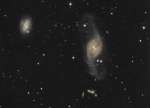 Extra Galaxies
17.07.2008
(xxxedit and linkxxx) A careful look at the full field of view for this sharp image reveals a surprising number of galaxies both near and far toward the constellation Ursa Major. The most striking is clearly NGC 3718, the warped spiral galaxy right of center.
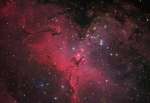 M16 and the Eagle Nebula
19.07.2008
Young star cluster M16 is surrounded by natal clouds of cosmic dust and glowing gas also known as The Eagle Nebula. This beautifully detailed image of the region includes fantastic shapes made famous in well-known Hubble Space Telescope close-ups of the starforming complex.
 NGC 7822 in Cepheus
28.08.2009
Pillars of gas, dust, and young, hot stars fill the center of NGC 7822. At the edge of a giant molecular cloud toward the northern constellation Cepheus, the glowing star forming region lies about 3,000 light-years away. Within the nebula, bright edges and tantalizing shapes are highlighted in this colorful skyscape.
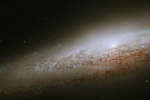 NGC 2683: Spiral Edge On
11.10.2010
Does spiral galaxy NGC 2683 have a bar across its center? Being so nearly like our own barred Milky Way Galaxy, one might guess it has. Being so nearly edge-on, however, it is hard to tell.
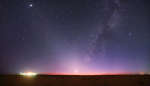 Skylights Over Libya
28.12.2010
Sometimes the sky itself seems to glow. Usually, this means you are seeing a cloud reflecting sunlight or moonlight. If the glow appears as a faint band of light running across the whole sky, you are probably seeing the combined light from the billions of stars that compose our Milky Way Galaxy.
|
January February March April May |
|||||||||||||||||||||||||||||||||||||||||||||||||