
|
You entered: apod
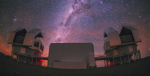 An Active Night over the Magellan Telescopes
21.02.2017
The night sky is always changing. Featured here are changes that occurred over a six hour period in late 2014 June behind the dual 6.5-meter Magellan Telescopes at Las Campanas Observatory in Chile.
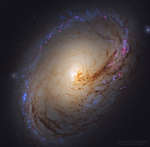 Spiral Galaxy M96 from Hubble
12.06.2019
Dust lanes seem to swirl around the core of Messier 96 in this colorful, detailed portrait of the center of a beautiful island universe. Of course M96 is a spiral galaxy, and counting...
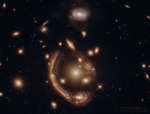 A Molten Galaxy Einstein Ring Galaxy
5.07.2022
It is difficult to hide a galaxy behind a cluster of galaxies. The closer cluster's gravity will act like a huge lens, pulling images of the distant galaxy around the sides and greatly distorting them. This is just the case observed in the featured image recently re-processed image from the Hubble Space Telescope.
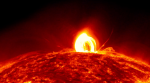 Coronal Rain on the Sun
26.02.2013
Does it rain on the Sun? Yes, although what falls is not water but extremely hot plasma. An example occurred in mid-July 2012 after an eruption on the Sun that produced both a Coronal Mass Ejection and a moderate solar flare. What was more unusual, however, was what happened next.
 The Dark River to Antares
21.02.2015
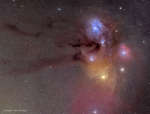
Connecting the Pipe Nebula to the colorful region near bright star Antares is a dark cloud dubbed the Dark River, flowing from the picture's left edge. Murky looking, the Dark River's appearance is caused by dust obscuring background starlight, although the dark nebula contains mostly hydrogen and molecular gas.
 Clouds of Andromeda
4.01.2017
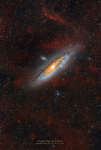
The beautiful Andromeda Galaxy is often imaged by planet Earth-based astronomers. Also known as M31, the nearest large spiral galaxy is a familiar sight with dark dust lanes, bright yellowish core, and spiral arms traced by blue starlight.
 Stars and Dust in Corona Australis
18.10.2017
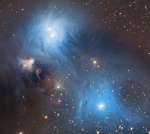
Blue dust clouds and young, energetic stars inhabit this telescopic vista, less than 500 light-years away toward the northern boundary of Corona Australis, the Southern Crown. The dust clouds effectively block light from more distant background stars in the Milky Way.
 Mercury Visualized from MESSENGER
11.12.2017
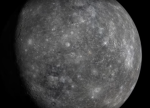
What would it be like to fly over the planet Mercury? Images and data taken from NASA's robotic MESSENGER spacecraft that orbited Mercury from 2011 to 2015 have been digitally combined to envision a virtual flight that highlights much of the hot planet's surface.
 Parker: Sounds of the Solar Wind
21.01.2020
What does the solar wind sound like? A wind of fast moving particles blows out from our Sun, and although space transmits sound poorly, particle impact and variable-field data from NASA's near-Sun Parker Solar Probe is being translated into sound.
 A Lucky Lunar Eclipse
3.04.1996
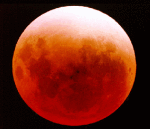
Tonight's full moon would normally washout the spectacle of Comet Hyakutake's lovely tail, even for those far from light polluted skies. Except that tonight comet observers are in luck - the dance of the planets calls for a total lunar eclipse! Lunar eclipses are caused when the Moon passes through the Earth's shadow.
|
January February March April May June July August September |
|||||||||||||||||||||||||||||||||||||||||||||||||