
|
You entered: apod
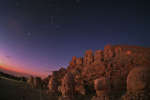 Orion Dawn Over Mount Nemrut
16.12.2008
What's that in front of Orion? Forty kilometers north of Kahta, Turkey, lies Mount Nemrut, a mountain adorned with the fragments of vast statues built over 2000 years ago. The stone sculptures once...
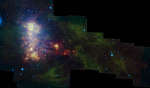 The Tail of the Small Magellanic Cloud
7.01.2010
A satellite galaxy of our Milky Way, the Small Magellanic Cloud is wonder of the southern sky, named for 16th century Portuguese circumnavigator Ferdinand Magellan. Some 200,000 light-years distant in the constellation Tucana...
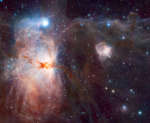 The Flame Nebula in Infrared
12.01.2010
What lights up the Flame Nebula? Fifteen hundred light years away towards the constellation of Orion lies a nebula which, from its glow and dark dust lanes, appears, on the left, like a billowing fire. But fire, the rapid acquisition of oxygen, is not what makes this Flame glow.
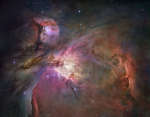 Orion Nebula: The Hubble View
15.07.2012
Few cosmic vistas excite the imagination like the Orion Nebula. Also known as M42, the nebula's glowing gas surrounds hot young stars at the edge of an immense interstellar molecular cloud only 1,500 light-years away.
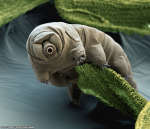 Tardigrade in Moss
6.03.2013
Is this an alien? Probably not, but of all the animals on Earth, the tardigrade might be the best candidate. That's because tardigrades are known to be able to go for decades without...
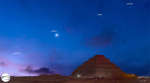 Planets Over Egyptian Pyramid
4.05.2022
The early morning planet parade continues. Visible the world over, the planets Jupiter, Venus, Mars and Saturn have been lining up in the pre-dawn sky since mid-April. In the featured image taken last month, these planets were captured over the Step Pyramid of Djoser, a UNESCO World Heritage Site.
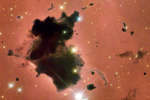 Thackerays Globules
28.12.2008
Rich star fields and glowing hydrogen gas silhouette dense, opaque clouds of interstellar gas and dust in this Hubble Space Telescope close-up of IC 2944, a bright star forming region in Centaurus, 5,900 light-years away. The largest of these dark globules, first spotted by South African astronomer A. D.
 Welcome to the International Year of Astronomy
1.01.2009
Astronomers all over planet Earth invite you to experience the night sky as part of the International Year of Astronomy 2009. This year was picked by the International Astronomical Union and the United Nations Educational, Scientific, and Cultural Organization because it occurs 400 years after Galileo turned one of the first telescopes toward the heavens.
 Seyferts Sextet
10.12.2013
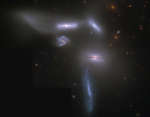
What will survive this battle of the galaxies? Known as Seyfert's Sextet, this intriguing group of galaxies lies in the head portion of the split constellation of the Snake (Serpens). The sextet actually contains only four interacting galaxies, though.
 Tutulemma: Solar Eclipse Analemma
22.12.2013
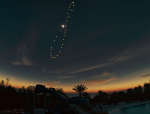
If you went outside at exactly the same time every day and took a picture that included the Sun, how would the Sun's position change? With great planning and effort, such a series of images can be taken. The figure-8 path the Sun follows over the course of a year is called an analemma.
|
January February March April May June July August September |
|||||||||||||||||||||||||||||||||||||||||||||||||