
|
You entered: star
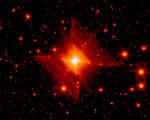 MWC 922: The Red Square Nebula
16.12.2012
What could cause a nebula to appear square? No one is quite sure. The hot star system known as MWC 922, however, appears to be embedded in a nebula with just such a shape. The above image combines infrared exposures from the Hale Telescope on Mt.
 Portrait of NGC 281
27.11.2014
Look through the cosmic cloud cataloged as NGC 281 and you might miss the stars of open cluster IC 1590. But, formed within the nebula, that cluster's young, massive stars ultimately power the pervasive nebular glow.
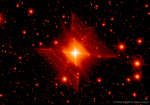 MWC 922: The Red Square Nebula
31.01.2016
What could cause a nebula to appear square? No one is quite sure. The hot star system known as MWC 922, however, appears to be embedded in a nebula with just such a shape. The featured image combines infrared exposures from the Hale Telescope on Mt.
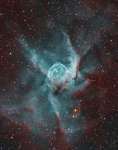 NGC 2359: Thor s Helmet
16.02.2019
NGC 2359 is a helmet-shaped cosmic cloud with wing-like appendages popularly called Thor's Helmet. Heroically sized even for a Norse god, Thor's Helmet is about 30 light-years across. In fact, the helmet...
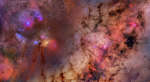 Scorpius Enhanced
16.06.2021
If Scorpius looked this good to the unaided eye, humans might remember it better. Scorpius more typically appears as a few bright stars in a well-known but rarely pointed out zodiacal constellation. To get a spectacular image like this, though, one needs a good camera, a dark sky, and some sophisticated image processing.
 APOD: 2023 February 23 Arp 78: Peculiar Galaxy in Aries
23.02.2023
Peculiar spiral galaxy Arp 78 is found within the boundaries of the head strong constellation Aries. Some 100 million light-years beyond the stars and nebulae of our Milky Way galaxy, the island universe is an enormous 200,000 light-years across.
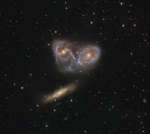 APOD: 2026 July 3 Б Three Galaxies in Pavo
3.07.2026
Some 190 million light-years away, far beyond the bright stars and nebulae of the Milky Way, these three galaxies are drawn together by gravity in a mesmerizing cosmic dance. Clearly distorted by galactic-scale gravitational interactions, large spiral galaxies NGC6769 and NGC6770 are seen face-on, with luminous galactic disks scarred by obscuring interstellar dust lanes.
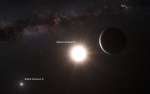 A View from Next Door
18.10.2012
Located just next door, Alpha Centauri is the closest star system to the Sun. A view from our interstellar neighbor a mere 4.3 light-years away is shown in this illustration. The Sun is at the upper right, a bright star against the background of the Milky Way.
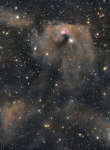 T Tauri and Hind s Variable Nebula
10.02.2022
The star with an orange tint near top center in this dusty telescopic frame is T Tauri, prototype of the class of T Tauri variable stars. Next to it (right) is a yellow cosmic cloud historically known as Hind's Variable Nebula (NGC 1555).
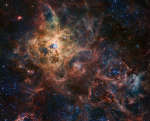 The Tarantula Nebula
26.02.2016
The Tarantula Nebula is more than a thousand light-years in diameter, a giant star forming region within nearby satellite galaxy the Large Magellanic Cloud, about 180 thousand light-years away. The largest, most violent star...
|
January February March April May June July August September |
|||||||||||||||||||||||||||||||||||||||||||||||||