
|
You entered: star
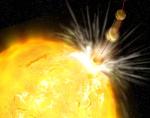 HD 82943: Planet Swallower
18.05.2001
Stars like HD 82943 are main sequence G dwarf stars with temperatures and compositions similar to the Sun. Also like the Sun, HD 82943 is known to have at least two giant planets, but unlike gas giants in our solar system their orbits are not nearly circular and bring them closer to the parent star.
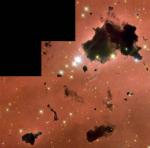 Thackeray's Globules
8.01.2002
Rich star fields and glowing hydrogen gas silhouette dense, opaque clouds of interstellar gas and dust in this Hubble Space Telescope close-up of IC 2944, a bright star forming region in Centaurus, 5,900 light-years away. The largest of these dark globules, first spotted by South African astronomer A. D.
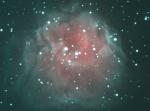 Sharpless 212 in Hydrogen and Sulfur
18.12.2001
Where do the most massive stars form? Observational evidence indicates that the outskirts of developing open clusters of stars are primary locations. Pictured above is one such open cluster: Sharpless 212. Visible in the image center are massive stars in the open cluster.
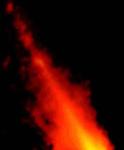 Rings Around Beta Pictoris
8.02.2000
An unusual dust disk surrounds nearby star Beta Pictoris. Discovered in 1983, astronomers are still learning just how unusual this disk is. Recent images and computer simulations indicate that the disk contains several elliptical dust rings larger than our own Solar System.
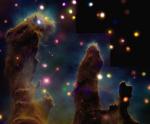 APOD: 2007 February 24- X rays and the Eagle Nebula
24.02.2007
The premier Chandra X-ray Observatory images of M16, the Eagle Nebula, show many bright x-ray sources in the region. Most of the x-ray sources are energetic young stars. They are seen here as colored spots superimposed on the Hubble's well-known optical view of M16's light-year long Pillars of Creation.
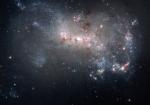 NGC 4449: Close Up of a Small Galaxy
10.07.2007
Grand spiral galaxies often seem to get all the glory. Their newly formed, bright, blue star clusters along beautiful, symmetric spiral arms are guaranteed to attract attention. But small irregular galaxies form stars too, like NGC 4449, located about 12 million light-years away.
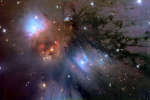 NGC 2170: Still Life with Reflecting Dust
7.07.2013
In this beautiful celestial still life composed with a cosmic brush, dusty nebula NGC 2170 shines at the upper left. Reflecting the light of nearby hot stars, NGC 2170 is joined by other bluish reflection nebulae, a compact red emission region, and streamers of obscuring dust against a backdrop of stars.
 APOD: 2024 November 12 Б NGC 6888: The Crescent Nebula
12.11.2024
How was the Crescent Nebula created? Looking like an emerging space cocoon, the Crescent Nebula, visible in the center of the featured image, was created by the brightest star in its center. A leading progenitor hypothesis has the Crescent Nebula beginning to form about 250,000 years ago.
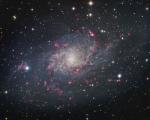 M33: Spiral Galaxy in Triangulum
24.09.2003
The small constellation Triangulum in the northern sky harbors this magnificent face-on spiral galaxy, M33. Its popular names include the Pinwheel Galaxy or just the Triangulum Galaxy. M33's diameter spans over 50,000 light-years, making it third largest in the Local Group of galaxies after the Andromeda Galaxy (M31), and our own Milky Way.
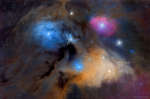 The Colorful Clouds of Rho Ophiuchi
14.10.2020
The many spectacular colors of the Rho Ophiuchi (oh'-fee-yu-kee) clouds highlight the many processes that occur there. The blue regions shine primarily by reflected light. Blue light from the Rho Ophiuchi star system and nearby stars reflects more efficiently off this portion of the nebula than red light.
|
January February March April May June July August September |
|||||||||||||||||||||||||||||||||||||||||||||||||