
|
You entered: telescope
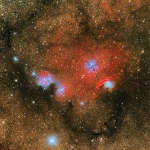 NGC 6559: East of the Lagoon
7.10.2021
Slide your telescope just east of the Lagoon Nebula to find this alluring field of view in the rich starfields of the constellation Sagittarius toward the central Milky Way. Of course the Lagoon nebula is also known as M8, the eighth object listed in Charles Messier's famous catalog of bright nebulae and star clusters.
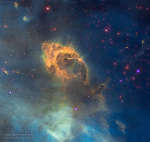 HH 666: Carina Dust Pillar with Jet
14.12.2021
To some, it may look like a beehive. In reality, the featured image from the Hubble Space Telescope captures a cosmic pillar of dust, over two-light years long, inside of which is Herbig-Haro 666 -- a young star emitting powerful jets.
 Messier 24: Sagittarius Star Cloud
28.06.2023
Unlike most entries in Charles Messier's famous catalog of deep sky objects, M24 is not a bright galaxy, star cluster, or nebula. It's a gap in nearby, obscuring interstellar dust clouds that allows a view of the distant stars in the Sagittarius spiral arm of our Milky Way galaxy.
 Spiral Galaxy NGC 6744
1.11.2024
Big, beautiful spiral galaxy NGC 6744 is nearly 175,000 light-years across, larger than our own Milky Way. It lies some 30 million light-years distant in the southern constellation Pavo but appears as only a faint smudge in the eyepiece of a small telescope.
 APOD: 2025 April 15 Б Planetary Nebula NGC 1514 from Webb
15.04.2025
What happens when a star runs out of nuclear fuel? For stars like our Sun, the center condenses into a white dwarf while the outer atmosphere is expelled into space to appear as a planetary nebula.
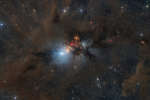 NGC 1333: Stellar Nursery in Perseus
30.01.2026
NGC 1333 is seen in visible light as a reflection nebula, dominated by bluish hues characteristic of starlight reflected by interstellar dust. A mere 1,000 light-years distant toward the heroic constellation Perseus, it lies at the edge of a large, star-forming molecular cloud.
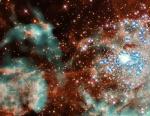 Star Cluster R136 Bursts Out
30.07.2001
In the center of star-forming region 30 Doradus lies a huge cluster of the largest, hottest, most massive stars known. Known as R136, the cluster's energetic stars are breaking out of the cocoon of gas and dust from which they formed.
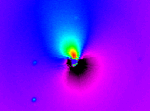 A Dust Jet From Hale-Bopp
29.07.1996
Approaching the inner Solar System, comet Hale-Bopp's icy nucleus is heated by sunlight, accelerating its production of dust and gas. Shrouded in the resulting cloud, known as the coma, the cometary nucleus remains hidden from direct view.
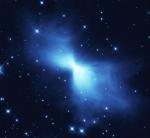 Cold Wind from the Boomerang Nebula
20.02.2003
A cold wind blows from the central star of the Boomerang Nebula. Seen here in a detailed false-color image recorded in 1998 by the Hubble Space Telescope, the nebula lies about 5,000 light-years away towards the grand southern constellation of Centaurus.
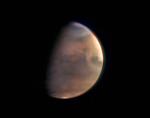 Express to Mars
18.12.2003
Hurtling toward its destination, the high resolution camera on board ESA's Mars Express spacecraft recorded this tantalizing view of the Red Planet earlier this month on December 3rd. Seen from a distance of 5.5 million kilometers, features across part of Mars' western hemisphere are bathed in sunlight.
|
January February |
|||||||||||||||||||||||||||||||||||||||||||||||||