
|
You entered: telescope
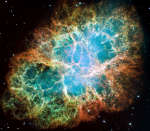 M1: The Crab Nebula from Hubble
25.12.2011
This is the mess that is left when a star explodes. The Crab Nebula, the result of a supernova seen in 1054 AD, is filled with mysterious filaments. The filaments are not only tremendously complex, but appear to have higher speed than expected from a free explosion.
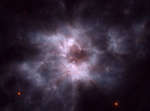 NGC 2440: Pearl of a New White Dwarf
16.05.2015
Like a pearl, a white dwarf star shines best after being freed from its shell. In this analogy, however, the Sun would be a mollusk and its discarded hull would shine prettiest of all!
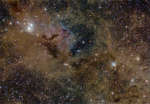 Stardust in Perseus
9.10.2015
This cosmic expanse of dust, gas, and stars covers some 6 degrees on the sky in the heroic constellation Perseus. At upper left in the gorgeous skyscape is the intriguing young star cluster IC 348 and neighboring Flying Ghost Nebula.
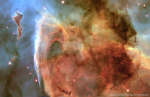 The Keyhole in the Carina Nebula
13.08.2016
The dark dusty Keyhole Nebula gets its name from its unusual shape. The looping Keyhole, in this featured classic image by the Hubble Space Telescope, is a smaller region inside the larger Carina Nebula.
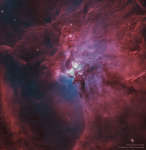 The Lively Center of the Lagoon Nebula
31.05.2020
The center of the Lagoon Nebula is a whirlwind of spectacular star formation. Visible near the image center, at least two long funnel-shaped clouds, each roughly half a light-year long, have been formed by extreme stellar winds and intense energetic starlight. A tremendously bright nearby star, Hershel 36, lights the area.
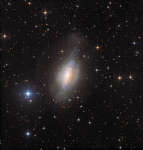 NGC 3521: Galaxy in a Bubble
1.04.2021
Gorgeous spiral galaxy NGC 3521 is a mere 35 million light-years away, toward the constellation Leo. Relatively bright in planet Earth's sky, NGC 3521 is easily visible in small telescopes but often overlooked by amateur imagers in favor of other Leo spiral galaxies, like M66 and M65.
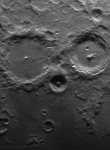 Alphonsus and Arzachel
16.07.2021
Point your telescope at tonight's first quarter Moon. Along the terminator, the shadow line between night and day, you might find these two large craters staring back at you with an owlish gaze. Alphonsus (left) and Arzachel are ancient impact craters on the north eastern shores of Mare Nubium, the lunar Sea of Clouds.
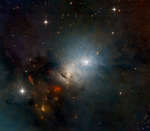 NGC 1333: Stellar Nursery in Perseus
10.11.2021
NGC 1333 is seen in visible light as a reflection nebula, dominated by bluish hues characteristic of starlight reflected by interstellar dust. A mere 1,000 light-years distant toward the heroic constellation Perseus, it lies at the edge of a large, star-forming molecular cloud.
 Virgo Cluster Galaxies
16.04.2025
Galaxies of the Virgo Cluster are scattered across this nearly 4 degree wide telescopic field of view. About 50 million light-years distant, the Virgo Cluster is the closest large galaxy cluster to our own local galaxy group.
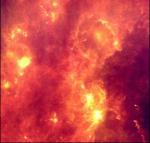 IRAS Orion
31.07.1998
Do you recognize the constellation Orion? This striking but unfamiliar looking picture of the familiar Orion region of the sky was produced using survey data from the InfraRed Astronomical Satellite (IRAS). It combines information...
|
January February |
|||||||||||||||||||||||||||||||||||||||||||||||||