
|
You entered: constellation
 NGC 7331 Close Up
6.02.2018
Big, beautiful spiral galaxy NGC 7331 is often touted as an analog to our own Milky Way. About 50 million light-years distant in the northern constellation Pegasus, NGC 7331 was recognized early on as a spiral nebula and is actually one of the brighter galaxies not included in Charles Messier's famous 18th century catalog.
 M22 and the Wanderers
11.04.2018
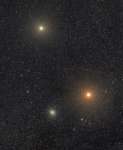
Wandering through the constellation Sagittarius, bright planets Mars and Saturn appeared together in early morning skies over the last weeks. They are captured in this 3 degree wide field-of-view from March 31 in a close celestial triangle with large globular star cluster Messier 22.
 NGC 1499: The California Nebula
22.08.2019
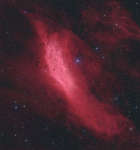
Drifting through the Orion Arm of the spiral Milky Way Galaxy, this cosmic cloud by chance echoes the outline of California on the west coast of the United States. Our own Sun also lies within the Milky Way's Orion Arm, only about 1,500 light-years from the California Nebula.
 NGC 7331 Close Up
6.02.2020
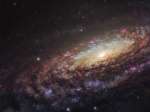
Big, beautiful spiral galaxy NGC 7331 is often touted as an analog to our own Milky Way. About 50 million light-years distant in the northern constellation Pegasus, NGC 7331 was recognized early on as a spiral nebula and is actually one of the brighter galaxies not included in Charles Messier's famous 18th century catalog.
 NGC 2359: Thor s Helmet
11.06.2020
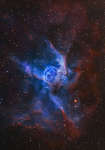
NGC 2359 is a helmet-shaped cosmic cloud with wing-like appendages popularly called Thor's Helmet. Heroically sized even for a Norse god, Thor's Helmet is about 30 light-years across. In fact, the helmet...
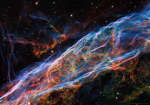 Veil Nebula: Wisps of an Exploded Star
4.04.2021
Wisps like this are all that remain visible of a Milky Way star. About 7,000 years ago that star exploded in a supernova leaving the Veil Nebula. At the time, the expanding cloud was likely as bright as a crescent Moon, remaining visible for weeks to people living at the dawn of recorded history.
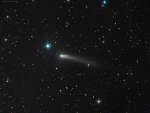 Rosetta's Comet in View
9.09.2021
Faint comet Churyumov-Gerasimenko (67P) sweeps past background stars in the constellation Taurus and even fainter distant galaxies in this telescopic frame from September 7. About 5 years ago, this comet's 4 kilometer spanning...
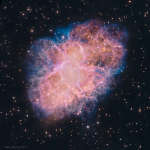 M1: The Crab Nebula
23.12.2021
The Crab Nebula is cataloged as M1, the first object on Charles Messier's famous 18th century list of things which are not comets. In fact, the Crab is now known to be a supernova remnant, debris from the death explosion of a massive star, witnessed by astronomers in the year 1054.
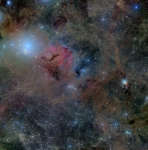 Stardust in Perseus
11.01.2023
This cosmic expanse of dust, gas, and stars covers some 6 degrees on the sky in the heroic constellation Perseus. At upper left in the gorgeous skyscape is the intriguing young star cluster IC 348 and neighboring Flying Ghost Nebula with clouds of obscuring interstellar dust cataloged as Barnard 3 and 4.
 APOD: 2023 May 1 Б Carina Nebula North
30.04.2023
The Great Carina Nebula is home to strange stars and iconic nebulas. Named for its home constellation, the huge star-forming region is larger and brighter than the Great Orion Nebula but less well known because it is so far south -- and because so much of humanity lives so far north.
|
January February |
|||||||||||||||||||||||||||||||||||||||||||||||||